
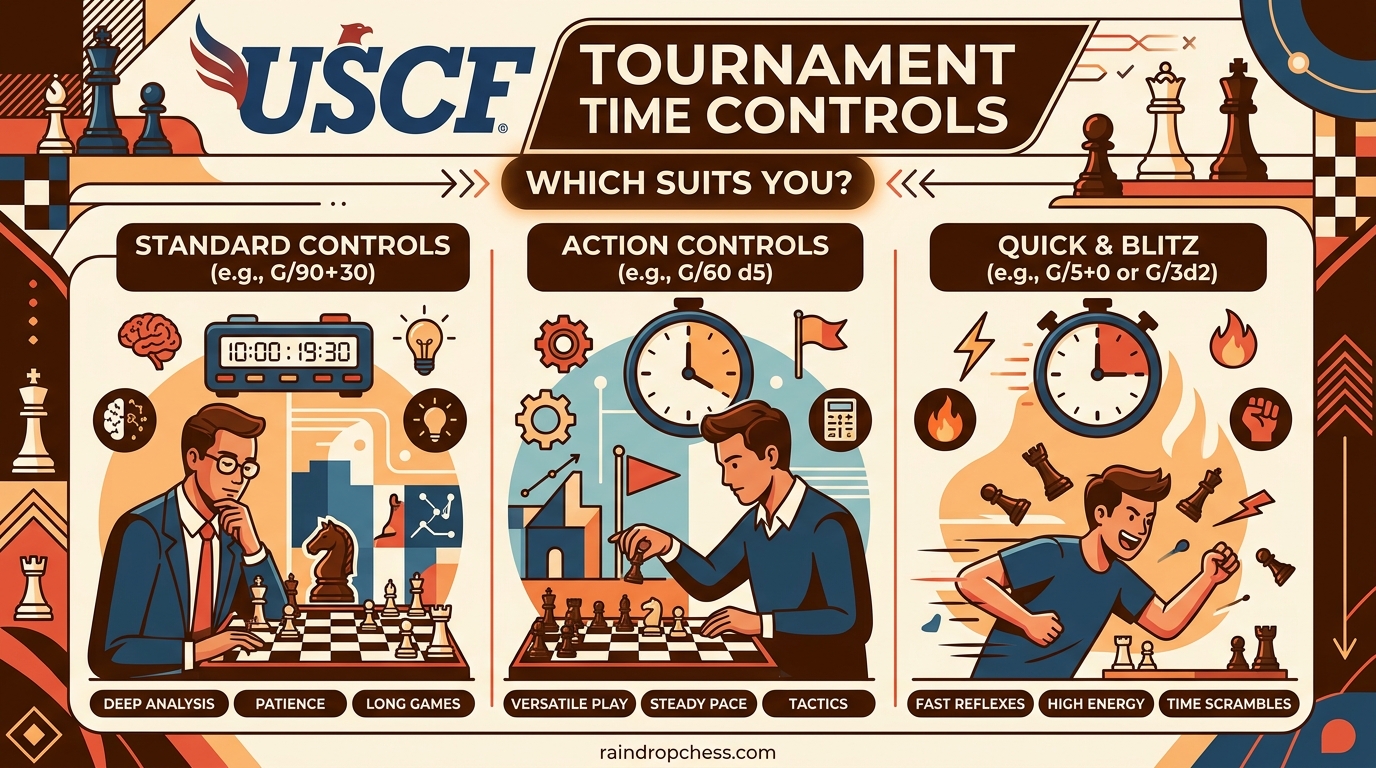
If you are preparing for your first rated event or looking to branch out into faster formats, understanding USCF tournament time controls is one of the most practical things you can do before sitting down at the board. The time control determines how long you have to play your moves, what kind of rating your game affects, and how the entire tournament schedule flows. I have played under every major USCF time control format, from weekday blitz to weekend classical events, and the difference in how you approach each one is significant.
This guide breaks down every time control category the United States Chess Federation recognizes, explains the notation you will see on tournament flyers, and helps you figure out which format fits your current skill level. Whether you are a beginner wondering what “G/60 d5” means on a tournament posting or an intermediate player deciding between quick chess and standard events, you will find a clear answer here.
USCF tournament time controls fall into three main categories: blitz, quick chess, and standard (also called regular). Each one has a specific time range, feeds into a different rating system, and creates a very different experience at the board. We will cover all of them, along with the often-confusing distinction between increment and delay, sudden death rules, and how to read those cryptic time control notations that appear on every tournament announcement.
Table of Contents
What Are Time Controls in Chess?
A time control is the total amount of time each player receives to complete their portion of a chess game during a tournament. Every player gets their own clock, and when it is your turn, your clock runs down. When you make a move and press the clock button, your time stops and your opponent’s clock begins counting down.
Time controls exist to keep tournaments running on schedule. Without them, a single game could stretch for hours and hold up an entire round for all the other players. They also add a strategic element to the game: managing your remaining time becomes just as important as managing your position on the board.
In USCF-rated events, the time control directly determines which of your ratings the game affects. A standard-rated game goes toward your regular (classical) rating. A quick chess game affects your quick rating. A blitz game updates your blitz rating. Understanding this connection helps you choose tournaments that will build the rating you care about most.
USCF Time Control Categories: Blitz, Quick, and Standard
The USCF divides tournament time controls into three distinct categories, each with its own time range and separate rating system. Knowing where the lines are drawn helps you understand what kind of event you are signing up for.
Blitz Chess Time Controls
Blitz chess covers any time control where each player has less than 10 minutes total. Common blitz formats include G/3 (three minutes per player), G/5, and G/5 with a 2-second delay. Some events use G/3 with a 2-second increment. Blitz games are fast, exciting, and unforgiving. One bad move can cost you the game before you have time to react.
Blitz games affect your USCF blitz rating, which is tracked separately from your regular and quick ratings. Blitz is popular at chess clubs on weeknights and as a side event at larger tournaments. It is a great way to get a lot of games in a short period, but it rewards pattern recognition and intuition more than deep calculation.
Quick Chess Time Controls
Quick chess, sometimes called rapid chess, includes any time control where each player has between 10 and 29 minutes. The most common quick chess format is G/15 with a delay or increment, but you will also see G/10, G/20, and G/25 at various events.
Quick chess has its own separate USCF rating. These games are long enough to think through positions somewhat but short enough that you cannot afford to spend five minutes on a single move. Quick chess events are often held as one-day tournaments with four to six rounds, making them a good option for players who want a full tournament experience without committing an entire weekend.
Standard (Regular) Chess Time Controls
Standard chess, also called regular chess by the USCF, includes any time control where each player receives 30 minutes or more. This is the traditional tournament format and the one most players think of when they picture a rated chess event. Standard games affect your regular USCF rating, which is the primary rating most players and organizers reference.
According to official USCF rules, for a game to count toward your regular rating, the duration of the first time-control period must be at least 30 minutes for each player. This means G/30 is the fastest time control that still qualifies for the regular rating system. Anything shorter goes into the quick or blitz category instead.
Standard time controls give you enough time to calculate variations, evaluate positions carefully, and play moves you have thought through. This is where deep understanding of chess principles, opening preparation, and endgame knowledge matter most. If you are serious about improving as a chess player, standard time controls are where you should spend the majority of your tournament time.
Common USCF Tournament Time Controls You Will See
While the USCF allows many different time control formats, a handful of them show up at tournaments far more frequently than others. Here are the ones you are most likely to encounter and what each one feels like in practice.
G/30 (Game in 30 Minutes)
G/30 is the shortest standard time control and is extremely popular for one-day tournaments. These events typically run four rounds on a Saturday or Sunday, with each round taking about 90 minutes including setup and transitions. You have 30 minutes for all your moves, so you need to keep a steady pace throughout the game. A typical G/30 event might pair this with a 5-second delay (written as G/30 d5) to give players a small buffer on each move.
I have found G/30 to be a great format for players who want the standard-rated experience without spending an entire weekend. The games are long enough to play real chess but short enough that you can play four rounds and still be home for dinner.
G/60 (Game in 60 Minutes)
G/60 gives each player one hour, making it the most balanced time control for weekend Swiss tournaments. You have enough time to think through complex middlegame positions, but you still need to manage your clock carefully. Many weekend tournaments use G/60 d5 (60 minutes with a 5-second delay), which gives you a small safety net on every move without significantly extending the total game time.
This is the time control I recommend most often for intermediate players. It strikes a comfortable balance between thinking time and tournament logistics. A G/60 event with three or four rounds fits neatly into a single day.
G/90 (Game in 90 Minutes)
G/90 is the workhorse time control for serious USCF tournament play. Each player gets 90 minutes, and games typically last 2.5 to 3 hours including the delay or increment. Multi-day weekend tournaments often use G/90 d5 or G/90 with a 30-second increment. This gives you enough time to work through difficult positions without extreme time pressure.
Reddit users and forum discussions consistently mention G/90 as the most common time control for standard USCF events at larger tournaments. If you are playing in a Friday night through Sunday tournament, there is a good chance you will be playing G/90.
G/120 (Game in 120 Minutes)
G/120 gives each player two full hours. This is classical chess at its most deliberate. You have time to calculate deep variations, consider multiple candidate moves, and carefully evaluate endgame transitions. Games under G/120 can last three to four hours each.
This time control appears most often at state championships, important classical events, and tournaments where organizers want to give players the maximum thinking time. It is less common at regular club tournaments simply because the time commitment is significant for both players and organizers.
40/90 With a Secondary Time Control
Some tournaments, especially multi-day events, use a two-stage time control. The most common is 40/90 SD/30 d5 or 40/90 with a 30-second increment. This means you get 90 minutes to make your first 40 moves. After move 40, you receive an additional 30 minutes (or the increment kicks in) to finish the game.
Reddit players report that bigger three-day USCF events like the National Open or World Open often use 40/90 with 30-second delay or increment for the secondary time control. This format allows deep play in the opening and middlegame while ensuring the game finishes in a reasonable time frame.
How to Read Chess Tournament Time Notation
When you look at a tournament announcement, the time control is usually written in a specific notation that can look confusing at first. Once you know the pattern, reading these notations becomes second nature. Here is a breakdown of the most common formats.
G/30 means “Game in 30 minutes.” Each player gets 30 minutes for the entire game. The G stands for “Game” and the number is the total minutes.
SD/30 means “Sudden Death in 30 minutes.” This is essentially the same as G/30. The “sudden death” label emphasizes that once your 30 minutes are up, you lose on time. There is no secondary time control or move counter.
40/90 means you must make 40 moves within 90 minutes. The first number is the move count, and the second is the minutes. If you reach move 40 with time remaining, you typically get additional time to finish the game.
G/60 d5 means Game in 60 minutes with a 5-second delay. The “d5” suffix indicates the delay amount.
G/90 inc30 means Game in 90 minutes with a 30-second increment. Each move adds 30 seconds to your clock. Some announcements write this as G/90 +30.
40/90 SD/30 d5 is a multi-stage control. You get 90 minutes for your first 40 moves. After move 40, you receive 30 additional minutes of sudden death time, with a 5-second delay on each move.
When you see these notations on a tournament flyer, the key is to identify three things: how much total time you get, whether there is a delay or increment, and whether the control has multiple stages. Once you break it down into those three components, any notation becomes readable.
Increment vs Delay: What Is the Difference?
This is one of the most common questions new tournament players ask, and it is a distinction that genuinely affects how you play. Both increment and delay add a small amount of time per move, but they work in opposite ways on your clock.
How Time Delay Works
With a time delay (sometimes called a Bronstein delay), the clock pauses for a set number of seconds before your time starts counting down on each move. If the delay is 5 seconds and you move within those 5 seconds, your main clock never ticks down at all. If you take 12 seconds to move, the 5-second delay runs first, and then 7 seconds come off your main time.
The key feature of delay is that you never gain extra time. The delay simply protects you from losing time on quick moves. A 5-second delay is the most common value at USCF tournaments, though 10-second delays appear at some events as well.
Delay is especially useful in endgames where you need to make many moves quickly. With a 5-second delay, you can make instantaneous moves without your clock ever running, which prevents you from losing on time in a clearly winning position.
How Time Increment Works
With a time increment (often called a Fischer increment, named after Bobby Fischer who championed the idea), the extra time is added to your clock after you make your move. If the increment is 30 seconds and you have 10 minutes remaining when you move, your clock jumps to 10 minutes and 30 seconds once you press it.
Unlike delay, increment allows you to accumulate time. If you play several moves quickly, each one adds 30 seconds to your clock, and your total time actually increases. This is why many players prefer increment for longer games. It rewards efficient play and gives you a safety cushion for complicated positions.
The most common increment values at USCF events are 30 seconds for standard games and 2 to 3 seconds for blitz. Players on chess forums frequently mention that 30-second increment is their preferred setup because it provides enough time to record moves on a scoresheet without constantly worrying about the clock.
Which One Is Better?
Neither increment nor delay is objectively better. They serve slightly different purposes. Delay is simpler and works well for faster time controls where the goal is to prevent flagging on trivial moves. Increment rewards faster play and can help you build a time cushion for critical moments.
In practice, the choice is usually made by the tournament organizer, not the player. However, if you have a choice in an online or club setting, I recommend trying both to see which one feels more comfortable for your playing style. Many experienced players prefer increment for standard games and delay for faster formats.
Sudden Death Rules in USCF Play
The term “sudden death” in chess simply means that when your time runs out, you lose the game. There is no grace period, no extra time, and no second chance. Your clock hits zero, and the game is over.
The term comes from the era of analog chess clocks, which had a small physical flag on each side. As the minute hand approached the 12 o’clock position, it would slowly lift the flag, and when time expired, the flag would drop. This is where the chess term “flagging” comes from: when you win because your opponent’s time ran out, you “flagged” them. Even though modern digital clocks do not have physical flags, players still use the term.
Under USCF rules, if your opponent runs out of time and you have time remaining, you can claim a win. However, there is an important exception: if your opponent has no material to deliver checkmate (for example, a lone king), the game is declared a draw regardless of the clock. Additionally, if both players have insufficient material, the game is drawn.
Another rule to know: if your opponent runs out of time but you do not claim the win and instead keep playing, the game continues. The claim must be made. In tournaments using digital clocks with time display, this is usually straightforward since both players can see the clock. With analog clocks or in time scrambles, it can be more complicated, and directors may need to get involved.
Sudden death time controls are the most common format in USCF events. When you see G/30 or G/60 on a tournament listing, those are sudden death controls. Every second counts, and managing your time well is just as important as playing strong moves.
Which USCF Time Control Suits Your Skill Level
This is the question the article title asks, and it is the one most guides skip entirely. The right time control for you depends heavily on your experience level, your goals, and how much time you can commit to tournament play. Here is a breakdown by skill level.
Beginner Recommendations: Start Slow
If you are new to tournament chess or have been playing for less than a year, I strongly recommend starting with G/25 or G/30 with a 5-second delay. These time controls give you enough time to think through each move, consider your options, and learn from your mistakes in real time.
Forum discussions confirm this approach. First-time tournament players are often grouped with other beginners at slower time controls like G/25 d5, which creates a more relaxed environment for learning. The 5-second delay gives you a small buffer that prevents you from losing on time while you are still getting comfortable with using a chess clock.
Avoid blitz and bullet as your primary tournament format while you are learning. These fast time controls reward pattern recognition and intuition, which are skills that develop over time. Playing blitz before you understand fundamental principles can actually reinforce bad habits because you do not have time to think about why a move is good or bad.
One-day G/30 tournaments with four rounds are an ideal starting point. You get the full tournament experience: pairing announcements, rated games, results posted, and a USCF rating that starts building from day one. The time commitment is manageable, and the games are long enough to learn from.
Intermediate Recommendations: Build Depth
Once you have played 10 to 20 tournament games and feel comfortable managing a clock, G/60 with a delay or increment is the sweet spot. This gives you a full hour to work through positions, calculate variations, and apply the opening and endgame principles you have been studying.
At the intermediate level, G/60 forces you to start thinking about time management as a strategic tool rather than just a constraint. You learn when to spend extra time on a critical position and when to play a familiar move quickly to save your clock for later. These are skills that transfer directly to longer time controls.
I also recommend mixing in some G/90 games once you feel confident at G/60. The extra 30 minutes per side changes the character of the game significantly. You can calculate deeper, consider more candidate moves, and play more carefully in transition points between the opening, middlegame, and endgame.
Intermediate players should also consider playing quick chess (G/15 or G/20) as a supplement to standard games. Quick chess sharpens your tactical vision and forces you to make decisions faster, which actually improves your standard play by helping you recognize patterns more quickly.
Advanced and Competitive Recommendations: Test Yourself
Competitive players who are building toward a title norm or pushing their rating higher should primarily play G/90 or 40/90 with a 30-second increment. These are the time controls used at major USCF events, and they test every aspect of your chess ability: opening preparation, middlegame calculation, endgame technique, and time management under pressure.
The 40/90 format with a secondary time control is the standard for title norm events and major Swiss tournaments. Reddit discussions consistently identify this as the most common time control at prestigious three-day USCF tournaments. Playing this format regularly prepares you for the highest level of competition available in USCF-rated chess.
Advanced players should also maintain an active blitz practice routine. Playing G/5 or G/3 with increment sharpens your tactical awareness and helps you spot threats quickly, which pays dividends in longer games when you need to calculate efficiently. Many strong tournament players play 15 to 30 minutes of blitz daily as a warmup.
At this level, you should also experiment with different increment and delay settings to find what works best for your style. Some players thrive with a 30-second increment because they can build time for complex endgames. Others prefer a flat delay because they like the certainty of knowing exactly how much total time they have.
Tips for Managing Your Clock During Tournament Games
Understanding time controls is one thing. Managing your clock effectively during a game is a completely different skill, and it is one that takes deliberate practice to develop. Here are practical strategies that have helped me and many other tournament players.
Use the 40-40-20 rule. This is a well-known time management guideline. Roughly speaking, plan to spend about 40% of your time on the opening and early middlegame, 40% on the critical middlegame decisions, and hold 20% in reserve for the endgame. If you are playing G/60, that means roughly 24 minutes for moves 1 through 15, 24 minutes for the complex middlegame phase, and 12 minutes saved for the endgame and any time scrambles.
Do not spend more than 3 minutes on a single move unless the position absolutely demands it. In a G/60 game, spending 5 minutes on one move eats up nearly 10% of your total time. Unless you are at a critical branching point where the wrong move loses the game, try to keep individual move times between 30 seconds and 2 minutes.
Write your moves efficiently. If your tournament uses a time control with increment, use the increment time to record your moves on the scoresheet. Many players write their move, then press the clock, which means the increment time covers the writing. If your event uses delay instead, write your move before pressing the clock so the delay time covers the recording.
Recognize time trouble early. Zeitnot, or time trouble, happens when you have very little time left and still many moves to play. The best way to handle time trouble is to avoid it entirely by maintaining a steady pace throughout the game. If you do find yourself in time trouble, focus on making reasonable moves quickly rather than trying to find the absolute best move. A good move played in 5 seconds beats a perfect move that takes 45 seconds when you only have 2 minutes remaining.
Practice with a clock at home. Set your chess clock to the tournament time control and play practice games. This builds your internal sense of pacing. After a few dozen timed practice games, you will develop a feel for how long you can afford to think at different points in the game without constantly looking at the clock.
How to Choose the Right Tournament for Your Time Control Preference
Now that you understand the different time controls and which one suits your level, the practical question is how to find tournaments that use your preferred format. Here is what I look for when choosing events.
Read the tournament announcement carefully. Every USCF-sanctioned tournament publishes an announcement (often called a TLA, or Tournament Life Announcement) that lists the time control for each section. This is where you will see the G/60 d5 or 40/90 SD/30 d5 notation. If the time control is not listed, contact the organizer directly before registering.
One-day events typically use faster controls. Saturday or Sunday one-day tournaments almost always run G/30 or G/25 with a delay. These events fit four rounds into a single day and are ideal for beginners and players with limited time. If you want standard-rated games without a full weekend commitment, look for these.
Multi-day weekend events use longer controls. Friday through Sunday tournaments use G/60, G/90, or 40/90 formats. These events have fewer rounds per day but much more thinking time per game. They are the best option for intermediate and advanced players who want to play serious, rated chess.
Check the US Chess tournament database. The US Chess Federation maintains a searchable database of upcoming rated events at uschess.org. You can filter by state, date, and tournament type. Each listing includes the time control, so you can find events that match your preference without guessing.
Ask at your local chess club. Club players know which local tournaments use which time controls, and they can recommend events that fit your level. Many clubs also run their own USCF-rated tournaments on a regular schedule, often with beginner-friendly time controls like G/25 d5 or G/30 d5.
Your first tournament does not need to be perfect. The most important thing is to start playing rated games. Once you have a few events under your belt, you will naturally develop a preference for certain time controls and seek out tournaments that match them.
FAQ
What are the time controls for USCF rating?
For a USCF regular (standard) rating, the first time-control period must be at least 30 minutes per player (G/30 or longer). Quick chess ratings cover games between 10 and 29 minutes per player. Blitz ratings apply to games under 10 minutes per player. Each category has its own separate USCF rating.
What is the 40-40-20 rule in chess?
The 40-40-20 rule is a time management guideline that suggests spending roughly 40% of your clock time on the opening and early middlegame, 40% on the critical middlegame decisions, and keeping 20% in reserve for the endgame. It helps players pace themselves and avoid running out of time in critical positions.
What is the point of time increments in chess?
Time increments add a set amount of time to your clock after every move. This ensures you always have at least some time to make your next move, even in endgames with many remaining moves. Increments also reward faster play by allowing you to accumulate time and reduce the chance of losing on time in a clearly winning position.
What are the time controls for chess tournaments?
Common USCF tournament time controls include G/30 (for one-day events), G/60 (for weekend Swiss tournaments), G/90 (for serious competitive play), and 40/90 with a secondary time control (for major multi-day events). Most controls include either a 5-second delay or a 30-second increment to give players a small time buffer on each move.
What is the difference between blitz and quick chess in USCF?
In USCF ratings, blitz chess covers any time control under 10 minutes per player, while quick chess covers 10 to 29 minutes per player. Blitz has its own blitz rating, and quick chess has a separate quick rating. Standard (regular) chess starts at 30 minutes per player and has its own rating as well.
Should beginners play with increment or delay?
Beginners should start with a time delay, usually 5 seconds, because it is simpler to understand and provides a consistent buffer on every move. Delay prevents you from losing time on quick moves without adding complexity. Once you are comfortable with tournament play, you can try increment to see if you prefer accumulating extra time for complex positions.
Conclusion
USCF tournament time controls are not as complicated as they first appear. The three categories (blitz under 10 minutes, quick chess 10 to 29 minutes, and standard 30 minutes and above) each serve a different purpose and feed into their own rating system. The notation becomes easy to read once you know that G means game time, d means delay, inc or + means increment, and numbers before the slash represent move counts.
For beginners, G/25 or G/30 with a 5-second delay is the best starting point. Intermediate players should gravitate toward G/60 events. Competitive players aiming for rating gains and title norms should focus on G/90 or 40/90 formats. The right time control for you is the one that matches your experience level and gives you room to think, learn, and enjoy the game.
Start playing rated games at whatever time control is available at your local club. Your rating and your preferences will both develop naturally as you gain experience across different formats. The most important step is showing up and playing.