
Chess Opening Strategy
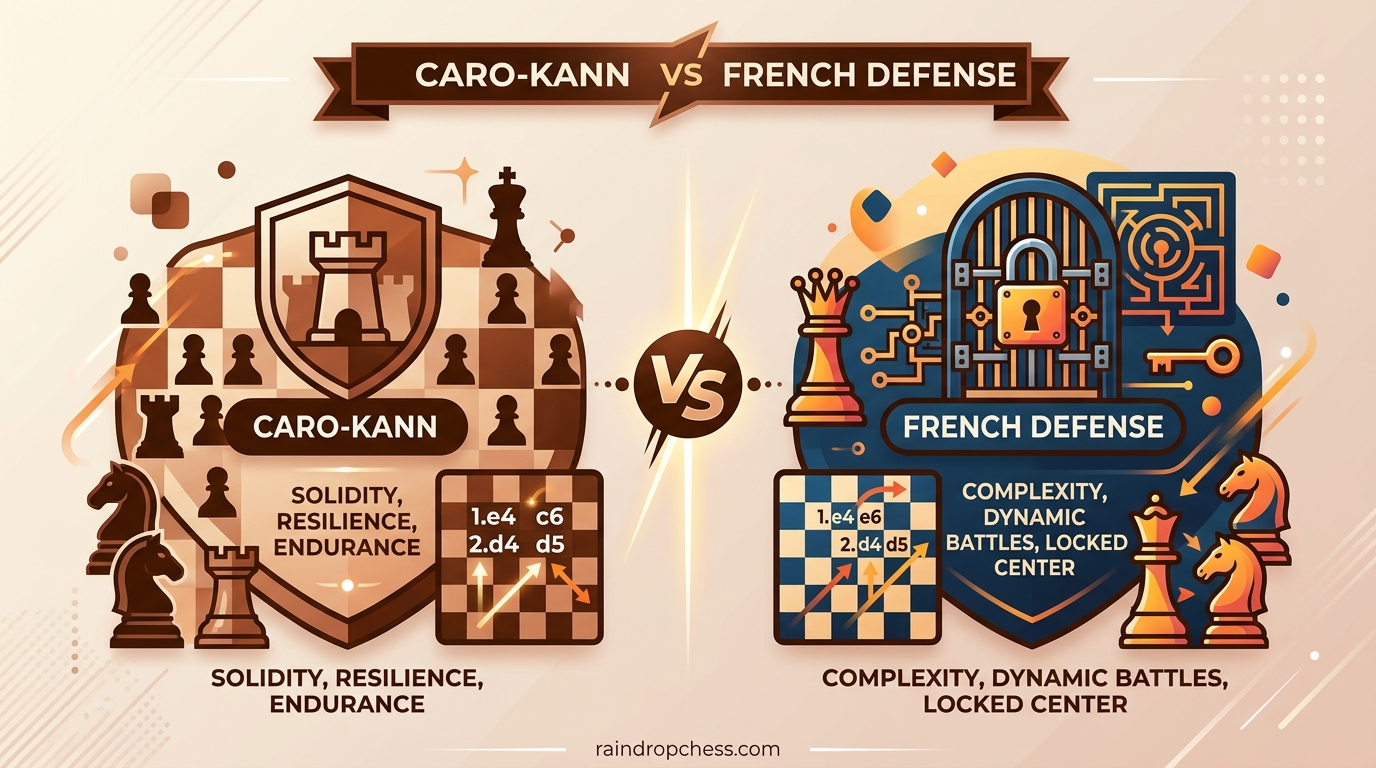
Every chess player using the black pieces faces a pivotal moment after 1.e4: which defensive system should become your go-to? Two of the most respected responses—the Caro-Kann Defense (1.e4 c6) and the French Defense (1.e4 e6)—appear superficially similar yet demand fundamentally different mindsets and skills. This comprehensive comparison will help you determine which opening aligns with your playing style, experience level, and strategic preferences.
Quick Overview: Both the Caro-Kann and French Defense are solid, time-tested responses to 1.e4. The key distinction lies in their philosophy: Caro-Kann prioritizes structural integrity and flexibility, while French Defense embraces dynamic counter-attacking chances.
Table of Contents
Understanding the Caro-Kann Defense (1.e4 c6)
The Caro-Kann Defense traces its origins to 19th-century European chess literature, with references appearing in games from the 1880s. Named after two analysts who popularized it—Horatio Caro and Marcus Kann—this opening has remained a favorite among positional players and world champions alike.
The defining characteristic of the Caro-Kann is its move order. By playing 1…c6 before committing to 1…e6, Black signals the intention to eventually push …d5 while preserving the light-squared bishop’s mobility. This seemingly small difference has profound implications for the resulting position.
The Caro-Kann Philosophy
Caro-Kann practitioners value stability above all else. The opening typically leads to:
- Solid pawn structure with no weaknesses after the central break
- Active piece development—both bishops can find effective squares
- Central flexibility—Black maintains options for pawn breaks
- Good endgame prospects due to harmonious pawn structure
The light-squared bishop, often cramped in other openings, remains relatively active in the Caro-Kann. When White eventually pushes c4, Black’s bishop can often retreat to e6 or f5 without becoming a liability.
Understanding the French Defense (1.e4 e6)
The French Defense emerged in the early 19th century and became one of Black’s most popular responses to 1.e4. Its name derives from a correspondence match between London and Paris in 1834, though the opening was analyzed earlier by various masters.
French Defense players embrace immediate confrontation. By playing 1…e6, Black immediately signals willingness to build toward the e5 push and challenges White’s central presence. This creates positions rich in strategic complexity and tactical opportunities.
The French Defense Philosophy
French Defense adherents seek dynamic imbalance over sterile equality:
- Counter-attacking potential—aggressive pawn breaks like …f6 and …Qb6
- Queenside expansion—a pawn avalanche often follows
- Central tension—permanent pawn struggles in the center
- Complexity—positions that favor creative players
The trade-off is the light-squared bishop, which becomes “bad” in many French structures. Black must often exchange it or accept a passive role. This acceptance of structural weakness in exchange for dynamic compensation defines the French temperament.
Direct Comparison: Caro-Kann vs French Defense
While both openings serve as Black’s defenses after 1.e4, their differences create distinct playing experiences. Here is a comprehensive comparison:
| Aspect | Caro-Kann Defense | French Defense |
|---|---|---|
| Move Order | 1.e4 c6, then 1…d5 | 1.e4 e6, then 1…d5 |
| Pawn Structure | Solid, flexible, fewer weaknesses | Sharper, with potential weaknesses |
| Light-Squared Bishop | Can develop to f5 or e6 easily | Often becomes passive or exchanged |
| Space | Equal space, sometimes cramped early | Initially cramped, expands later |
| Typical Play | Positional, maneuvering | Counter-attacking, tactical |
| Theoretical Depth | Moderate—focus on plans | Deep—many sharp lines |
| Endgame Prospects | Generally favorable | Context-dependent |
| Beginner-Friendliness | Easier to grasp concepts | Requires more study |
Why Caro-Kann Is Considered More Solid
Chess analysts and players frequently describe the Caro-Kann as “more solid” than the French Defense. This reputation stems from several interconnected factors:
Preserved Bishop Activity: In the Caro-Kann, Black’s light-squared bishop typically finds employment on f5 or e6 without becoming a liability. Compare this to the French, where the same bishop often becomes a target after …Bc8-e6, only to find itself blocked by Black’s own pawns.
Structural Integrity: The typical Caro-Kann structure—with pawns on e6, d5, and c6—creates fewer long-term weaknesses than the French’s e6+d5 configuration. The c6 pawn anchors d5 and prevents White from gaining the c4 square easily.
Development Harmony: Pieces generally find natural squares in the Caro-Kann. The queen’s bishop develops to f5 or g4 without obstruction, and the knights have clear paths to c6 and f5.
Caro-Kann Defense: Strengths and Weaknesses
Caro-Kann Strengths
- Rock-solid pawn structure with no inherent weaknesses
- Flexible piece development—both bishops remain active
- Easy equality against most White systems
- Excellent endgame potential due to harmonious structure
- Less theoretical homework required for club level
- Good reputation at all rating levels
- Works well as a primary defense at all skill levels
Caro-Kann Weaknesses
- Can be perceived as passive by aggressive players
- Fewer winning chances against prepared opponents
- The d5 push often leads to exchanges, reducing complexity
- Bishop pair advantage is rare in main lines
- Limited counter-attacking opportunities in some lines
- Positions can become repetitive with precise play
French Defense: Strengths and Weaknesses
French Defense Strengths
- Dynamic counter-attacking chances at every level
- Creates queenside pawn expansion with real mating threats
- Positions favor creative, tactical players
- Many White players struggle against French structures
- Rich theoretical heritage with countless resources
- Can surprise unprepared opponents with sharp lines
- The Winawer Variation offers genuine winning chances
French Defense Weaknesses
- Light-squared bishop often becomes passive or traded
- Initial cramping can feel restrictive
- Requires significant theoretical study to play well
- Some lines lead to objectively worse positions
- White can choose Exchange Variation for drawish play
- Structural weaknesses persist into endgames
Which Opening Suits Your Playing Style?
Your chess personality should guide your opening choice more than any other factor. Consider these profiles to self-assess your fit for each defense:
Choose Caro-Kann If You Are:
- A positional player who prefers maneuvering over complications
- A beginner or intermediate player seeking reliable, easy-to-learn defenses
- Someone who values endgame play and converting advantages
- A player who wants consistent, repeatable positions with clear plans
- Someone with limited time for opening study who wants practical results
- A player who prefers solid, defensive setups that minimize risk
Choose French Defense If You Are:
- A tactical player who thrives in sharp, complex positions
- An aggressive competitor seeking counter-attacking opportunities
- Someone who enjoys queenside pawn storms and piece coordination
- A player willing to invest significant study time in opening theory
- Someone who prefers positions with imbalance and winning chances
- An advanced player comfortable handling double-edged positions
Rating Level Considerations
Beginners (Under 1200 Rating)
New players benefit most from the Caro-Kann Defense. Its logical move order mirrors standard opening principles—develop pieces, control the center, castle safely. The opening teaches fundamental chess concepts without overwhelming beginners with theory. Bad bishop problems and cramped positions frustrate learning when they stem from opening choices rather than middle-skill errors.
Club Players (1200-1800 Rating)
Club-level players can meaningfully explore both defenses. The Caro-Kann offers reliable equality and fewer theoretical landmines. The French Defense rewards deeper study and can punish opponents who have not prepared specific lines. At this level, personal preference should dominate the decision.
Tournament Players (1800+ Rating)
Advanced players typically maintain both openings in their repertoire or specialize based on their style. Many top GMs have used both successfully—Anatoly Karpov favored the Caro-Kann for its positional subtlety, while others like Alexander Rubinstein achieved masterpieces with the French. Your choice should reflect your tournament preparation and opponent pool.
Famous Players and Historical Examples
Caro-Kann Masters
Mikhail Botvinnik — Used it throughout his World Championship career
Anatoly Karpov — Primary defense, showcased its positional beauty
Garry Kasparov — Employed it in critical games against Topalov
French Defense Masters
Siegbert Tarrasch — Classic advocate and theorist
Akiba Rubinstein — Elegant positions from French structures
Vladimir Kramnik — Used it as a surprise weapon in title matches
Botvinnik’s games with the Caro-Kann demonstrated how the opening’s flexibility allows Black to transition smoothly between middlegame plans. Karpov’s expertise showed how subtle positional advantages—better pawn structure, more active pieces—compound into decisive victories. Meanwhile, French Defense games from Tarrasch’s era established the opening’s theoretical foundation and showcased its counter-attacking potential.
Key Variations in Each Defense
Major Caro-Kann Variations
- Exchange Variation (3.exd5 cxd5): Creates isolated queen’s pawn positions; dry but strategically rich
- Advance Variation (3.e5): White challenges Black’s center; leads to blocked positions with maneuvering
- Classical Variation (3.Sc3 d5 4.g3): Solid approach; both sides develop naturally
- Botvinnik Variation (4.h3): Preventing …Lg4; forces original piece placement
Major French Defense Variations
- Exchange Variation (3.exd5 exd5): Symmetrical structure; often leads to draws with precise play
- Advance Variation (3.e5): Sharp play; the Milner-Barry Gambit (5.b4) offers compensation
- Winawer Variation (3.Sc3 Ab4): Double-edged; Black accepts doubled pawns for activity
- Tarrasch Variation (3Sd2): Modern approach; avoids main theory while keeping options
Time Investment for Mastery
Practical consideration: how much study does each opening require for adequate preparation?
Caro-Kann offers better return on study investment for most players. The core concepts—develop toward the center, castle queenside, find the light-squared bishop’s best square—translate directly to improved play. A club player can achieve competent Caro-Kann play with 20-30 hours of focused study and practical experience.
French Defense demands more extensive preparation. The Winawer alone contains dozens of critical sub-variations, and White has numerous sharp try-reject (3…Ab4, 4.e5, etc.) that require specific knowledge. Serious French players should expect 50-100+ hours of study to feel confident across all major lines.
Frequently Asked Questions
Is French Defense good for beginners?
French Defense is not ideal for absolute beginners due to its tactical complexity and the need to understand pawn structures deeply. The Caro-Kann offers a gentler learning curve. However, once a player understands basic opening principles, the French can be learned effectively. For beginners below 1200 rating, we recommend starting with Caro-Kann and exploring French Defense after reaching intermediate level.
Why is the Caro-Kann considered more solid than the French Defense?
The Caro-Kann’s reputation for solidity comes from three factors: (1) Its pawn structure contains fewer permanent weaknesses after …d5, (2) the light-squared bishop typically remains active without needing to be exchanged, and (3) positions generally offer less dynamic compensation to White, resulting in more equal positions. This structural integrity translates to reliable results even against stronger opponents.
What are the main disadvantages of French Defense?
The French Defense’s primary drawbacks include: the light-squared bishop often becomes passive or must be exchanged; initial space cramping can limit piece mobility; White can force drawish Exchange lines if seeking peace; and some variations (like the Winawer) accept structural weaknesses for compensation that may not materialize against accurate play. Additionally, the theoretical knowledge required to play French Defense well exceeds that of the Caro-Kann.
Which is the strongest defense in chess: Caro-Kann or French?
Neither opening is objectively stronger—both are completely sound at all levels of play, including World Championship use. The “strongest” defense depends entirely on your style and preparation. At the highest levels, both have been used successfully by multiple World Champions. Caro-Kann offers more reliable equality; French offers greater dynamic potential. Choose based on how you want to play, not theoretical strength.
Can grandmasters still use these openings at the top level?
Absolutely. Grandmasters regularly employ both defenses at the highest levels. Karpov’s use of the Caro-Kann against Kasparov in their 1984-1985 World Championship match demonstrated its viability even in the most critical games. The French Defense has seen championship use throughout history and remains popular among elite players seeking dynamic play.
Decision Checklist: Finding Your Ideal Opening
Answer These Questions Honestly:
- Do I prefer quiet, maneuvering positions over sharp tactical battles?
- Am I willing to invest significant time in opening theory?
- Do I enjoy endgame play and converting positional advantages?
- Do I prefer counter-attacking or building my own attack first?
- How much time can I realistically dedicate to opening preparation?
- Do I want a “repertoire” defense or enjoy exploring multiple lines?
- Am I comfortable accepting structural weaknesses for dynamic compensation?
If you answered yes to questions 1, 3, 5 (limited time), and 7 (positional approach): Choose Caro-Kann Defense.
If you answered yes to questions 2, 4, 5 (significant time), and 8 (tactical approach): Choose French Defense.
Conclusion: Making Your Choice
Both the Caro-Kann Defense and French Defense represent legitimate, respected responses to 1.e4 that have stood the test of time at all levels of chess. The Caro-Kann offers structural solidity, easier equality, and positions that favor positional understanding. The French Defense provides dynamic counter-attacking chances, rich tactical opportunities, and positions that reward deep preparation.
Your opening choice should reflect your chess identity. There is no objectively “better” defense—only the defense that matches your style, study commitment, and goals. Many successful players maintain both in their repertoire, choosing based on tournament situation or opponent. Whichever you select, commit to understanding its underlying principles, not just memorizing moves. Mastery of either opening will serve you well throughout your chess journey.
The best opening is the one that allows you to play your best chess. Choose wisely, study deeply, and enjoy the game.