
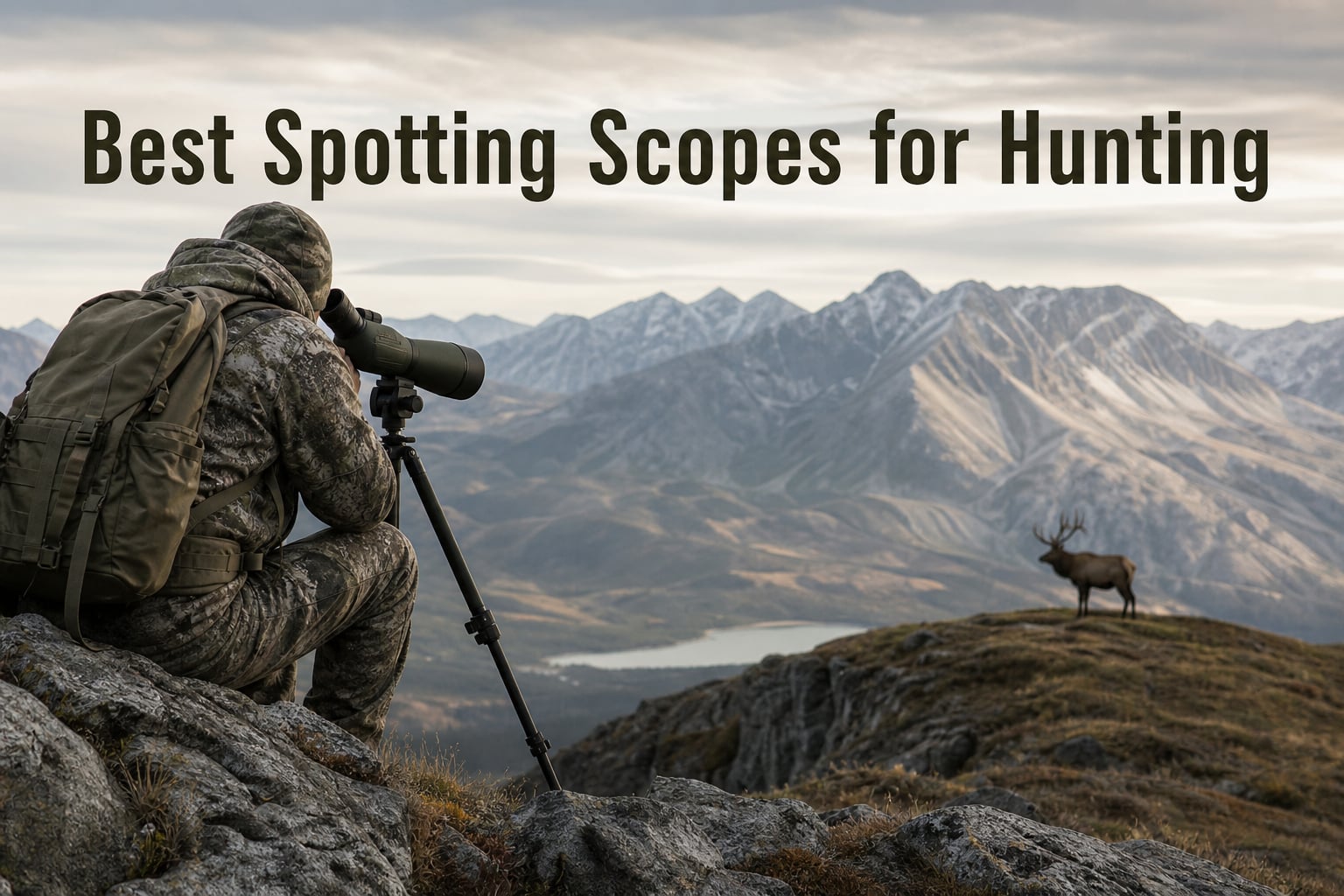
The best spotting scopes for hunting let you identify animals and study terrain from a distance instead of spending daylight and energy closing the gap. For open-country elk, mule deer, and long-range target work, a tripod-mounted spotter adds detail that binoculars generally cannot provide.
We reviewed the supplied product data for ten current models, looking at objective-lens size, stated magnification, glass and coating claims, weather sealing, mounting approach, weight where listed, and customer feedback. This is a data-led buying guide, not a claim that our team field-tested every scope, so each recommendation stays tied to documented features and the hunting job it fits.
A good hunting optic has to match the way you travel and glass. A 50mm scope makes sense for a pack-focused hunt, while 80mm and 85mm designs gather more light for a long evening behind the tripod; the extra brightness comes with bulk and a greater need for stable support.
The short answer is that the Vortex Diamondback HD 20-60×85 is the broadest full-size choice here because it combines HD optics, an 85mm objective, helical focus, an Arca-Swiss-compatible mount, and an unlimited unconditional lifetime warranty. The Vortex Viper HD 11-33×50 is the more sensible choice when pack weight comes first, while the Vortex Crossfire HD 20-60×80 gives hunters an 80mm HD platform with the same Arca-Swiss mounting convenience.
Table of Contents
The top three picks cover full-size, compact, and value-focused hunting needs
Start with the category that mirrors your hunt rather than simply chasing the highest number on the zoom ring. These three picks are the clearest starting points from the supplied specifications and review volume.
The badges describe fit, not a universal ranking. An 85mm scope is the better tool for stationary, far-reaching glassing, but it is not automatically the better partner for a steep walk-in hunt.
The best spotting scopes for hunting in 2026 are easiest to compare by objective size and mounting
This overview includes every reviewed model. Treat the stated magnification as a range to work within: the lower end normally gives a wider, brighter view for locating animals, while higher power asks more of the glass, atmosphere, and tripod.
| Product | Specifications | Action |
|---|---|---|
 Gosky 25-75×85 Gosky 25-75×85 |
|
View Details |
 Athlon Forerunner 20-60×80 Athlon Forerunner 20-60×80 |
|
View Details |
 Vortex Diamondback HD 20-60×85 Vortex Diamondback HD 20-60×85 |
|
View Details |
 Vortex Viper HD 11-33×50 Vortex Viper HD 11-33×50 |
|
View Details |
 Vortex Crossfire HD 20-60×80 Vortex Crossfire HD 20-60×80 |
|
View Details |
 Gosky Flagship 25-75×80 Gosky Flagship 25-75×80 |
|
View Details |
 Athlon Talos 20-60×80 Athlon Talos 20-60×80 |
|
View Details |
 Celestron Regal M2 80ED Celestron Regal M2 80ED |
|
View Details |
 Maven CS.1 15-45×65 Maven CS.1 15-45×65 |
|
View Details |
 Athlon Argos HD 20-60×85 Athlon Argos HD 20-60×85 |
|
View Details |
1.The Gosky 25-75×85 is a high-magnification kit with an included tripod
Gosky FalconPro Elite 25-75×85 Spotting Scope for Target Shooting
25-75x
85mm objective
BAK4 prism
Pros
- 85mm objective
- 25-75x range
- dual-speed focus
- tripod and phone adapter
Cons
- Plastic housing
- 27 reviews
The Gosky pairs a large 85mm objective with a 25-75x range, BAK4 prism, angled body, and dual-speed focusing system. Its stated nitrogen-purged, O-ring-sealed construction is relevant for hunters who will glass through wet mornings or temperature swings.
It is a complete starting kit because the listing includes a full-size tripod, carrying bag, and phone adapter. That convenience can reduce the number of parts a new spotter owner has to source before a first scouting trip.
The 85mm objective favors fixed-position evening glassing
An 85mm objective is built to collect more light than a compact 50mm or 65mm body. It is a logical fit for a truck-based glassing point, a range bench, or a base-camp setup where carrying a full-size tripod is reasonable.
At 75x, heat shimmer and tripod movement can become the limit before the zoom number does. Begin around 25x to find the animal or target, then increase power only when the view remains steady and useful.
The included accessories suit first-time spotter owners
The phone adapter makes this model a plausible entry into digiscoping, although alignment, a steady tripod, and daylight still determine the result. The supplied tripod is useful to have, but a hunter planning extended high-power observation should assess its rigidity in the field.
The 4.8 rating is based on 27 reviews, which is a small sample compared with several Vortex models here. Treat that favorable score as a useful signal, not the same depth of feedback as a product with hundreds of reviews.
2.The Athlon Forerunner 20-60×80 brings ED glass and a tripod to a full-size format
Athlon Optics 20-60×80 Dual Focus Forerunner Spotting Scope – ED Focal Lens with Tripod
20-60x
80mm objective
ED focal lens
Pros
- ED lens
- argon purged
- dual focus
- tripod included
Cons
- 13 reviews
- not Prime eligible
Athlon lists an extra-low-dispersion focal lens, fully multi-coated optics, an 80mm objective, and 20-60x magnification for the Forerunner. ED glass is intended to limit color fringing, which matters most when fine antler detail or a distant target edge sits against bright terrain.
The aluminum-bodied scope is listed at 2.47 kilograms packaged and includes a tripod. Argon purging, fogproof construction, rubber armor, a rotating ring, and a twist-up eyecup point to an all-weather, full-size design.
The dual-focus layout supports fast locating and careful detail checks
A dual-focus arrangement gives the hunter a quick way to get near focus and a finer control for the last adjustment. That is especially welcome when scanning between closer brush and a distant ridge rather than studying one fixed subject.
The 20x low end is more practical for initial searching than attempting every observation at maximum zoom. Move to 40x or 60x only after the scope, tripod, and atmosphere allow a clean view.
The limited review sample calls for measured expectations
The supplied rating is 4.8 from 13 reviews, and the review summary praises image quality and ED-lens performance. It is encouraging data, but the small sample means warranty terms and return conditions deserve attention before a major hunting trip.
This scope fits the hunter who wants documented ED glass and an included support setup, but does not need a compact backpacking body. Its full-size 80mm objective asks for room in the vehicle or pack plan.
3.The Vortex Diamondback HD 20-60×85 is the most complete full-size hunting choice
Vortex Diamondback HD Spotting Scope 20-60×85 Angled
20-60x85
HD optics
Arca-Swiss mount
Pros
- 85mm HD optics
- helical focus
- Arca mount
- unconditional warranty
Cons
- 3.8 lb
- requires 4 AA batteries
The Diamondback HD pairs a 20-60x range with an 85mm objective, fully multi-coated lenses, a helical focus wheel, adjustable eyecups, and an integrated sunshade. Vortex also specifies O-ring sealing, argon purging, Armortek lens protection, and an Arca-Swiss-compatible mounting foot.
With 450 reviews and a 4.7 rating in the supplied data, it has one of the deeper feedback pools in this lineup. Its listed 3.8-pound weight says plainly that this is a full-size scope for deliberate glassing rather than an ultralight packing choice.
The Arca-Swiss foot makes tripod selection more direct
Forum discussion repeatedly flags mounting confusion, especially the difference between an Arca-style clamp and a 1/4-20 threaded connection. This Diamondback can sit directly in a compatible Arca-Swiss clamp, which avoids adding a separate plate when the tripod head already uses that system.
Use a tripod rated for the scope and head together, then keep the center column low. A stable head and low center of gravity matter more to usable detail at 60x than an extra increment of advertised magnification.
The 85mm format suits wide-open country and low-light windows
The larger front lens supports a brighter view than a smaller objective at comparable magnification, a practical advantage when glassing shaded basins or the final legal-light period. No scope can remove the effects of haze, but good support lets the optical system show what conditions permit.
This is our broad recommendation for the hunter who regularly watches distant terrain from one position and wants a strong warranty record. Bring a packable but capable tripod; the scope’s usefulness rests on that foundation.
4.The Vortex Viper HD 11-33×50 is the lightest practical backcountry-oriented choice
Vortex Viper HD Spotting Scope (11-33×50 Angled)
11-33x50
1.7 lb
XR Plus coatings
Pros
- 1.7-pound weight
- Arca foot
- dual focus
- unconditional warranty
Cons
- 50mm objective
- 11-33x range
The Viper HD uses an 11-33×50 configuration, XR Plus lens coatings, dual focus knobs, rubber armor, and an Arca-Swiss-compatible foot. At a listed 1.7 pounds, it addresses the backcountry complaint that a full-size spotter can consume too much of a hunter’s weight budget.
The smaller objective and modest top magnification are intentional tradeoffs. This is a scope for carrying, locating, and confirming game detail at sensible distances, not a substitute for an 80mm or 85mm platform when distant detail at dusk is the central task.
The 11-33x range supports realistic handheld-to-tripod workflow
At 11x, the field of view is easier to search than at the high end of a 20-60x scope. A hunter can scan a basin, make a careful identification, and keep the view stable without asking as much of a light tripod.
The supplied data lists a 182-foot field of view, which reinforces that low-power, search-first use. For a hard 1,000-yard detail check, atmospheric conditions will still dictate whether 33x reveals enough information.
The compact body works best with an equally light but steady tripod
A small scope does not need a massive tripod, though a flimsy tabletop support can still frustrate it. Choose a tripod with a smooth pan head and a clamp that accepts the Arca-style foot, then test the setup before the hunt.
The Viper has a 4.7 rating from 421 reviews in the supplied data, with customer feedback specifically praising its light weight and dual-focus system. It is the cleanest recommendation for hunters who will carry their glass all day.
5.The Vortex Crossfire HD 20-60×80 provides a sturdy 80mm hunting platform
Vortex Crossfire HD Spotting Scopes (20-60×80 Angled)
20-60x80
HD optics
Arca-Swiss mount
Pros
- 80mm objective
- helical focus
- integrated sunshade
- unconditional warranty
Cons
- 3.3 lb
- not Prime eligible
The Crossfire HD is an angled 20-60×80 scope with fully multi-coated lenses, helical focus, adjustable eyecups, a built-in sunshade, rubber armor, nitrogen purging, and an Arca-Swiss-compatible mount. Its listed 3.3-pound weight is a little easier to manage than the 85mm Diamondback while retaining an 80mm objective.
The product data ranks it number two in spotting scopes and records a 4.7 rating from 335 reviews. That combination of feedback depth and a conventional full-size configuration makes it a clear option for a hunter building a stable glassing setup.
The 80mm objective balances brightness against pack burden
An 80mm scope is often the middle ground between 65mm portability and 85mm light collection. It remains a serious piece of equipment, but it gives more flexibility than an 85mm body when the route to a glassing knob is not trivial.
Use the sunshade when glare reaches the front element, and keep the objective and eyepiece covers in place while hiking. Lens coatings help transmission, but clean glass and shade management prevent avoidable loss of contrast.
The helical focus favors tracking changing distance
A helical wheel is easy to reach without moving far from the eyepiece. That makes small corrections convenient as you sweep from a foreground opening to far timber or shift from a herd to an adjacent ridge.
The Crossfire is one of the best spotting scopes for hunting when the priority is an 80mm angled scope with simple Arca mounting and a high-volume customer record. Pair it with a full-height tripod rather than relying on the included accessories of another kit.
6.The Gosky Flagship 25-75×80 is an accessory-rich option for casual glassing
Gosky Flagship Spotting Scope 25-75×80 with Tripod for Target Shooting
25-75x
80mm objective
BAK4 optics
Pros
- 80mm objective
- phone holder
- rotatable body
- 1/4-20 mount
Cons
- 4.5 lb
- manual focus
This Gosky Flagship lists a 25-75x zoom, 80mm objective, BAK4 prism, fully multi-coated optics, a rotatable body, rubber armor, retractable sunshade, and nitrogen-filled waterproof and fogproof protection. The listing also includes a tabletop tripod, carrying case, and quick phone holder.
Its 4.5-pound listed weight places it firmly in full-size territory. It is better viewed as a vehicle, range, or short-walk setup than a backpacking spotter, even though the case and accessories make transport straightforward.
The standard 1/4-20 thread works with many tripod systems
The product specifies a standard 1/4-20 tripod fitting. That is a common camera-style connection, but the scope’s weight and 75x setting still call for a rigid tripod and head rather than the small tabletop support supplied for convenience.
A hunter moving between platforms should check whether the tripod head needs an attached quick-release plate. That small compatibility check prevents the ARCA versus threaded-mount problem that comes up frequently in user discussions.
The phone holder favors daylight digiscoping experiments
A phone holder gives you a way to document a sighting or share a view, but it does not make a phone camera easy to align at high magnification. Start at low power, center the image, lock the tripod, and then increase magnification slowly.
The supplied data records 66 reviews and a 4.7 rating, with customers praising clarity and included accessories. It is appealing for someone who values an out-of-box kit and understands that manual focus takes a little practice.
7.The Athlon Talos 20-60×80 is a straightforward full-size option with broad feedback
Athlon Optics Talos 20-60×80 Spotter Scope, Black
20-60x
80mm objective
38 oz
Pros
- 38-ounce weight
- fully multi-coated
- nitrogen purged
- lifetime warranty
Cons
- Porro prism body
- tabletop mount
The Athlon Talos is listed as a 20-60×80 scope with fully multi-coated lenses, nitrogen purging, waterproof construction, an aluminum enclosure, and a 38-ounce weight. Its supplied data also notes a Porro-prism configuration and a lifetime transferable warranty.
This scope has a 4.6 rating drawn from 549 reviews, the largest feedback count in this group. That does not replace a personal inspection, yet it gives the Talos a more established customer record than several newer or lower-volume alternatives.
The 38-ounce figure makes this 80mm scope relatively manageable
Thirty-eight ounces is notable for an 80mm class scope, although the tripod, head, food, water, and shelter still decide the total pack burden. Hunters who count ounces should weigh the complete glassing system, not only the optic.
The stated 20-60x range gives the familiar full-size workflow: find at 20x, assess at moderate power, and reserve 60x for stable conditions. A lower setting commonly shows a brighter, wider image for the first search.
The tabletop mounting description deserves a compatibility check
The supplied listing identifies a tabletop mount, which may not meet the needs of standing or seated hillside glassing. Confirm the mount interface and choose a suitable field tripod before treating it as a long-session hunting setup.
The bulkier Porro-prism body is the other tradeoff. It can be perfectly acceptable for vehicle-based scouting, but a slimmer roof-prism design may pack more conveniently for a long hike.
8.The Celestron Regal M2 80ED is the flexible choice for digiscoping and eyepiece options
Celestron Regal M2 80ED Spotting Scope with ED Glass & Zoom Eyepiece
20-60x
80mm ED glass
dual focus
Pros
- ED glass
- dual focus
- rotating mount
- 1.25-inch eyepiece support
Cons
- 4.5 lb
- manual focus
The Regal M2 combines an 80mm ED objective with XLT coatings, phase- and dielectric-coated BaK-4 prisms, a 20-60x zoom eyepiece, and dual focus. Celestron also lists a magnesium-alloy body, rotating tripod mount, T-mount adapter, and compatibility with 1.25-inch astronomical eyepieces.
Those specifications make it especially interesting for an owner who wants one scope for hunting observation, wildlife viewing, and camera work. The 4.5-pound listing weight keeps it in the deliberate, full-size category.
The ED glass and coating package targets color control
ED glass is designed to reduce chromatic aberration, or colored fringes at high-contrast edges. Along with phase and dielectric prism coatings and XLT lens coatings, it is a documented optical package for hunters who care about fine contrast and natural color.
It is still wise to evaluate a scope at the magnifications you intend to use. The highest setting is not always the clearest setting, especially across sun-heated ground.
The included adapter expands digiscoping possibilities
The included T-mount adapter is a distinct advantage for a user planning DSLR digiscoping. The 1.25-inch eyepiece compatibility also offers an avenue for configuration beyond the supplied zoom eyepiece.
For hunting alone, that flexibility may be more than you need. For a hunter who also records wildlife or uses the scope for varied outdoor observation, it is a meaningful differentiator.
9.The Maven CS.1 15-45×65 is a premium-sized companion for carried hunts
Pros
- 65mm ED glass
- 40.4-ounce weight
- angled body
- lifetime warranty
Cons
- 45x maximum
- 59 reviews
The Maven CS.1 has a 15-45x range, 65mm ED objective, fully multi-coated optics, center focus, an angled body, waterproof and fogproof construction, and a stated 40.4-ounce weight. It is the model here most squarely aimed at the 65mm compromise between brightness and a carry-friendly footprint.
The 15x low end and 45x top end are sensible for real hunting use. It gives more reach than binoculars while avoiding the assumption that every observation must happen at 60x or 75x.
The 65mm class is best for long approaches and mobile glassing
Forum users often ask whether 65mm or 80mm is better. A 65mm scope makes sense when you carry it deep into the backcountry, frequently change glassing locations, or already have binoculars doing most wide-field scanning.
Choose 80mm or 85mm instead when the scope will stay near a road, camp, or a long-duration observation point and the later part of the day is central to your plan. Objective size is a use-case decision, not a simple quality ranking.
The angled body reduces strain during extended sessions
An angled eyepiece allows a lower tripod setup and a more relaxed neck position when several people of different heights share the scope. It also helps when observing uphill from a seated position.
The supplied data records a 4.5 rating from 59 reviews and highlights clarity, color accuracy, and smooth focusing. Consider it if the backcountry hunting spotting scope brief matters more than maximum magnification.
10.The Athlon Argos HD 20-60×85 is a large-objective angled scope for stationary glassing
Athlon Optics Argos HD 20-60×85 Spotting Scope – 45 Degree, Green/Black
20-60x
85mm HD glass
45-degree angle
Pros
- 85mm objective
- HD glass
- argon purged
- rotating tripod ring
Cons
- 68 ounces
- 4.4 rating
The Argos HD supplies a 20-60x range, 85mm objective, advanced HD glass, fully multi-coated lenses, a 45-degree angled eyepiece, argon-purged waterproof and fogproof construction, and a rotating tripod ring. It also has a rubber-armored body and soft case in the stated package.
At 68 ounces, it is the heaviest listed model in this group. That weight is not a flaw when the scope lives at a truck, camp, or dedicated glassing point, but it is a clear planning factor for a backcountry hunter.
The 85mm objective helps when light collection is the priority
A large 85mm front lens is a logical choice for long-range glassing where you expect to sit behind the optic for a while. It can provide a brighter exit pupil than a smaller objective at the same power, though fog, haze, and a shaky tripod still limit the view.
The angled 45-degree eyepiece and rotating ring are practical for getting a comfortable viewing position without raising the tripod excessively. That helps keep the system more stable during long observation sessions.
The customer feedback shows more tradeoffs than the top Vortex models
The supplied product data gives the Argos HD a 4.4 rating from 270 reviews and notes some quality-control concerns within the review summary. The large review count is useful, but shoppers should read recent feedback closely and inspect focus and alignment promptly.
Choose this model for the 85mm, angled, full-size concept rather than for light packing. It is best matched to patient glassing from a fixed point with a strong tripod.
The buying decision starts with matching objective size to your hunting distance and carry plan
Start by naming the job. A scope for occasional confirmation from a truck is different from a scope that must ride in a backpack for days, and a scope for calling impacts at a range is different again.
The four factors that change the decision most are objective diameter, useful magnification, eyepiece angle, and tripod interface. Optical glass and coatings matter, but they only perform as well as the stability and conditions around them.
A 50mm, 65mm, 80mm, or 85mm objective fits a different hunting rhythm
A 50mm model such as the Viper HD favors carrying ease and a lower, more stable magnification range. It is an intelligent choice when your binoculars handle most scanning and the scope is for a closer look after you find an animal.
A 65mm model such as the Maven CS.1 is the middle ground for backcountry hunting: more light gathering and reach than a 50mm, with less physical burden than the 80mm and 85mm class. An 80mm or 85mm scope is best when you can support the weight and expect serious dawn, dusk, or distant-basin glassing.
A 20-60x range is usually enough when the tripod and atmosphere cooperate
Magnification should be treated as a working range, not a promise that maximum power is always productive. Lower power gives a wider field of view and typically an easier, brighter image, making it better for locating game and tracking movement.
For many hunters, 20x to 40x is the productive range for routine glassing, while 45x to 60x is for a stable confirmation look. A 75x setting can be useful in excellent conditions, but heat waves, wind, and vibration often remove the gain.
For long-range shooting, choose the power that makes bullet impacts readable without turning every tremor into a blur. A quality tripod and a solid head often improve the usable view more than chasing additional magnification.
An angled scope is usually more comfortable for long sessions, while a straight scope is faster to point
Angled spotting scopes let you keep the tripod lower and tend to be easier on the neck during long glassing sessions or uphill observation. They also work well when multiple hunters of different heights share one setup, since changing eye position requires less tripod adjustment.
A straight scope can be quicker to aim in the same direction as your binoculars, and some hunters prefer it from a vehicle window or when tracking a distant animal through cover. Neither shape is universally better; comfort, setup height, and your usual terrain should decide it.
A rigid tripod and compatible head make a spotting scope usable at high power
A good tripod for a spotting scope has enough load capacity for the scope and head, a smooth pan-and-tilt or ball head, and legs that remain stable at your typical viewing height. Carbon legs reduce carry weight, while aluminum commonly offers a heavier but dependable alternative.
Check the attachment method before buying. Arca-Swiss-compatible scopes such as the Vortex Diamondback, Viper, and Crossfire can go into an Arca clamp, whereas a 1/4-20 scope may need a plate; do not assume a tabletop tripod will be stable enough for an 80mm or 85mm scope.
Weather sealing, clean lenses, and sensible expectations matter more than extreme zoom
Every scope here lists some form of waterproof or fogproof protection, but lens caps, dry storage, and avoiding abrupt temperature changes still help. Nitrogen or argon purging addresses internal fogging; it does not prevent exterior condensation on a cold morning.
Clean lenses with a blower and proper lens cloth rather than a shirt hem. Dust, fingerprints, glare, and an unshaded objective can reduce contrast before optical resolution ever becomes the limiting factor.
Digiscoping works best when you begin at low power and build a stable setup
Phone adapters included with the Gosky scopes can make casual digiscoping accessible, while the Celestron’s T-mount adapter supports a more camera-focused arrangement. In either case, align the camera at low magnification, center the exit pupil, stabilize the tripod, and then increase power only as the image permits.
Digiscoping is best viewed as a record of an observation, not a replacement for a dedicated long lens. Wind, camera shake, the scope’s exit pupil, and the subject’s movement all become more apparent as magnification rises.
The most common spotting-scope questions have practical, scenario-based answers
What is a good tripod for a spotting scope?
A good spotting-scope tripod is rigid enough for the scope and head, has a smooth pan head, and uses a compatible attachment system. For 80mm and 85mm scopes, use a full-height tripod rather than a light tabletop model; keep the center column low for a steadier view.
Which is better: straight or angled spotting scope?
Angled spotting scopes are usually more comfortable for long glassing sessions and allow a lower, steadier tripod setup. Straight scopes can be quicker to point in the same direction as binoculars and may suit vehicle use. Choose based on comfort, terrain, and how you normally glass.
What is the minimum distance for a spotting scope?
Minimum focus distance varies by model and is not supplied for every scope in this guide. A spotting scope is primarily a distance optic, so check the manufacturer specification if you need to observe objects at close range; binoculars are usually simpler for nearby subjects.
How far can a spotting scope see?
A spotting scope can show distant terrain and game as far as line of sight allows, but useful identification depends on magnification, objective size, optical quality, tripod stability, heat shimmer, light, and the size of the subject. Distance alone does not predict a clear view.
What magnification do I need for a spotting scope?
For hunting, start with a low setting around 15x to 25x to locate game, then use roughly 30x to 45x for detail when conditions are good. A 20-60x scope covers most full-size use, while 11-33x or 15-45x designs are sensible for lighter carried setups.
The right hunting spotter is the one you can carry, mount, and use patiently
The Vortex Diamondback HD 20-60×85 is the strongest all-around full-size recommendation, the Vortex Viper HD 11-33×50 is the standout for weight-conscious hunts, and the Vortex Crossfire HD 20-60×80 is a practical 80mm choice with an Arca-Swiss foot. The Maven CS.1 deserves close attention when a 65mm ED-glass scope better fits your backcountry route.
For the best spotting scopes for hunting in 2026, make the final call from your terrain, glassing distance, support system, and tolerance for carried weight. Pick the tripod interface first, use low power to search, and let the conditions tell you when more magnification is actually useful.
2 thoughts on “10 Best Spotting Scopes for Hunting (September 2026) Reviewed”