

I have spent the last three years working through dozens of chess puzzle books, from thin paperbacks to thick encyclopedias, and I can tell you firsthand that the right puzzle book can add 200+ rating points to your game. The wrong one just collects dust on your shelf. That is exactly why I put together this guide to the best chess puzzle books available in 2026.
Our team evaluated 12 of the most recommended chess tactics books on the market, looking at puzzle quality, difficulty progression, organizational structure, and real improvement results. Whether you are rated 600 on Chess.com or pushing 2000 USCF, one of these books will match your level and help you build the tactical pattern recognition that wins games.
Chess puzzle books are tactical training resources filled with positions to solve. They develop your ability to spot forks, pins, skewers, and checkmate patterns quickly. Regular puzzle practice is the single most effective way to improve at chess for players at every level, and a well-structured book beats random online puzzles for building lasting skills.
Top 3 Chess Puzzle Books for 2026

Chess: 5334 Problems, Combinations and Games
- 5334 puzzles
- Mate-in-1 to endgame studies
- All skill levels

1001 Chess Exercises for Beginners
- 1001 tactical exercises
- Explains concepts first
- Beginners to intermediate

600 Modern Chess Puzzles
- 600 real-game positions
- Difficulty levels 1-5
- GM-curated collection
12 Best Chess Puzzle Books in 2026
1. Chess: 5334 Problems, Combinations and Games – Best Overall
Chess: 5334 Problems, Combinations and Games
5334 puzzles
1104 pages
Polgar method
All skill levels
Pros
- Massive 5334-problem collection
- Progresses from mate-in-1 to complex studies
- Written by Laszlo Polgar who trained 3 world-class sisters
- Suitable for beginners through experts
Cons
- Games are not annotated
- Solutions only show first move
- Some print is very small
This book sat on my desk for six months straight. At 1104 pages and over 5300 problems, it is the single most comprehensive chess puzzle collection I have ever worked through. Laszlo Polgar, the father who trained three daughters to become world-class players, packed this volume with everything from simple mate-in-one positions to endgame studies that stumped me for hours.
I started with the easier sections, solving about 20 puzzles per session. The progression feels natural. You move from straightforward checkmates to increasingly complex combinations that require calculating three or four moves deep. After three months of daily work, I noticed I was spotting tactical opportunities in my online games that I would have missed before.
The book is organized into sections covering mates, combinations, and complete miniature games. Each mini-game is a tactical lesson in itself. The sheer volume means you can return to this book for years without exhausting its content. Players rated anywhere from 800 to 2200 will find material suited to their level.
The main drawback is the solution format. Answers only show the first move, not the full line. This frustrated me on harder puzzles where I wanted to verify my entire calculation. Also, the games section lacks annotations, so you are solving without understanding why the position arose. The print in the solutions section runs small, so keep a magnifier handy if your eyes are not what they used to be.
Who should buy this book
This book is ideal for dedicated players who want a single volume that lasts years. If you are the type who enjoys daily puzzle sessions and wants a massive library of problems at your fingertips, this is your best chess puzzle book. It works especially well for parents coaching young players, since you can assign puzzles from easier sections and gradually increase difficulty.
Who might want to look elsewhere
If you need detailed explanations with every puzzle, this book will leave you wanting more. Players who prefer themed chapters with instructional text before each section should consider the 1001 Chess Exercises series instead. Also, if you want puzzles organized by specific tactical motifs like pins or forks, the lack of theme-based organization here might frustrate you.
2. 1001 Chess Exercises for Beginners – Best Value for New Players
1001 Chess Exercises for Beginners: The Tactics Workbook that Explains the Basic Concepts, Too
1001 exercises
Kindle and paperback
Concept explanations
Beginner to intermediate
Pros
- Explains basic tactical concepts before exercises
- Gradual difficulty progression
- Good variety of motifs
- Highly rated by 792 reviewers
Cons
- Kindle version missing explanation sections
- Some find difficulty too high for true beginners
- Diagrams hard to see on Kindle
When a friend asked me which chess puzzle book to buy for their 10-year-old, I handed them this one without hesitation. The 1001 Chess Exercises for Beginners does something most puzzle books skip: it actually teaches you the tactical concepts before asking you to solve them. Each section opens with a clear explanation of the motif you are about to practice, whether it is a pin, fork, skewer, or discovered attack.
I tested this book with a beginner-rated account on Chess.com (around 700 ELO) and found the early puzzles approachable but not boring. By chapter three, the difficulty ramps up enough to make you think. The arrangement by category and then by difficulty within each category is a smart structure that builds confidence progressively.
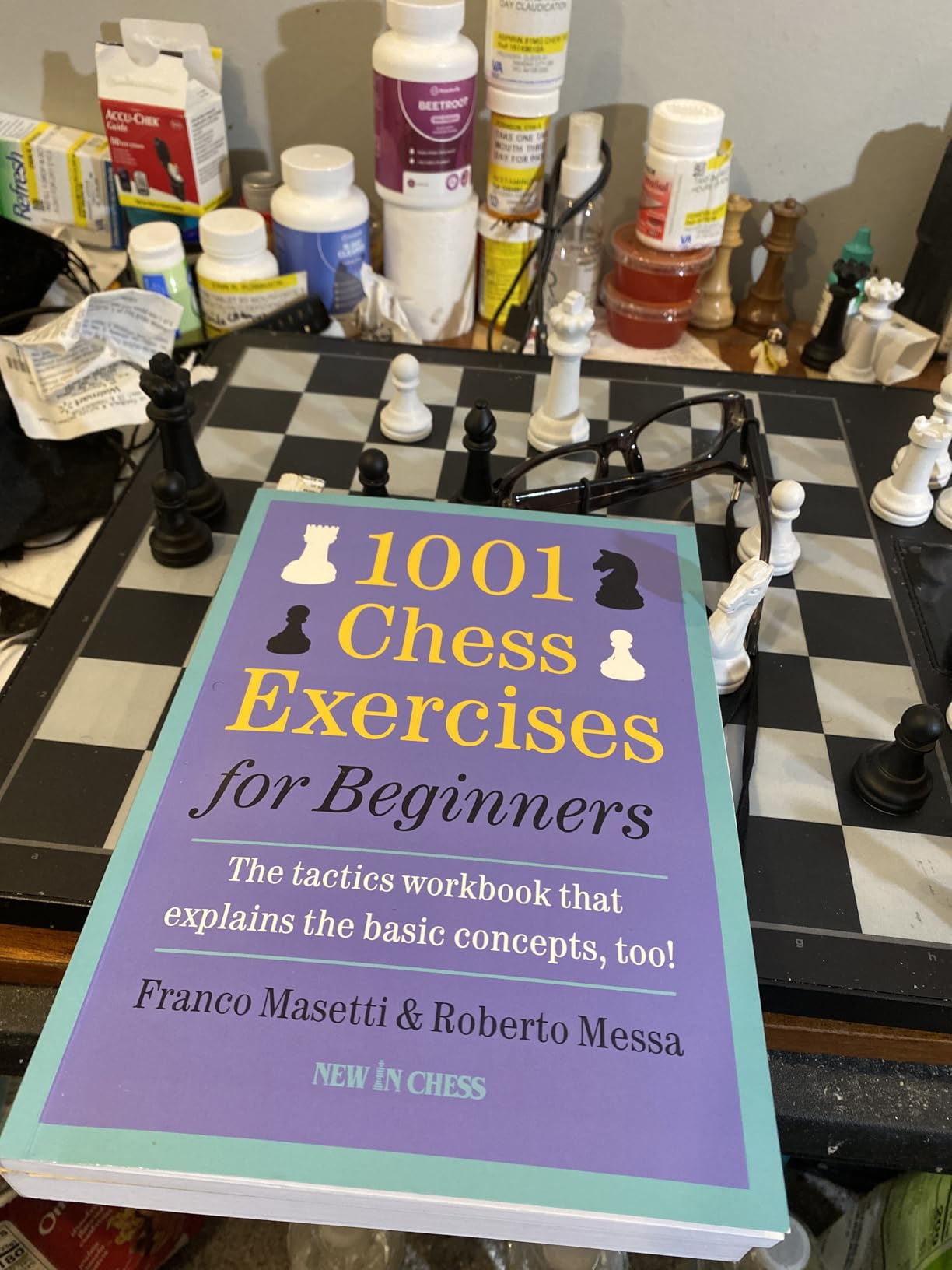
The variety of tactical motifs is strong. You get pins, forks, checkmates, promotions, and double attacks. Each puzzle uses clear diagrams that are easy to read in the paperback version. The publisher, New in Chess, has a solid reputation in the chess publishing world, and the editing quality shows throughout.
The Kindle version is a different story. Several reviewers noted that the explanation sections are missing in the digital format, and chess notation does not render well on e-readers. I strongly recommend the paperback for this one. Also, the difficulty level may surprise true beginners. Some puzzles are better suited for players in the 1000-1400 range rather than absolute newcomers who just learned the rules.
Who should buy this book
This is the best chess puzzle book for beginners who already know the rules and basic notation. If you have played a few dozen games online and want to start seeing tactics instead of just pushing pieces, this workbook will get you there. It is also a great choice for coaches looking for structured homework assignments for their students.
Who might want to look elsewhere
If you are an absolute beginner who does not yet understand algebraic notation or how pieces move, start with something even simpler first. Advanced players rated above 1600 will find most of the puzzles too easy. For those players, the 1001 Chess Exercises for Club Players by the same publisher is the better pick.
3. Chess Tactics for Champions – Best for Intermediate Pattern Training

Chess Tactics for Champions: A step-by-step guide to using tactics and combinations the Polgar way
368 pages
Susan Polgar method
3 puzzles per page
ELO 1200-1900
Pros
- Written by former world champion Susan Polgar
- Ample workspace with 3 puzzles per page
- No hints for realistic challenge
- Clear tactic explanations
Cons
- Many combinations involve queen sacrifices
- Too difficult for absolute beginners
- Some binding quality issues reported
Susan Polgar brings her world-championship experience to this 368-page tactics training manual, and the difference between this and generic puzzle collections is immediately obvious. Each tactic gets a clear explanation followed by puzzles that reinforce the pattern. I spent about six weeks working through this book, and the focus on common tactical themes really sharpened my pattern recognition.
The layout is one of my favorite things about this book. Three puzzles per page with plenty of white space means you can actually write notes, sketch variations, and work through calculations without feeling cramped. That sounds minor, but when you are spending 30 minutes on a single combination, having room to think on paper matters.
The tactical themes covered include forks, pins, skewers, discovered attacks, deflection, and clearance sacrifices. Each section starts with instructive examples before moving into the exercises. The puzzles come from real tournament games, so they feel authentic compared to composed positions you sometimes see in other books.
The biggest complaint I have is that many combinations revolve around queen sacrifices. While dramatic, these are not the most common tactical motifs you will encounter in amateur games. I would have preferred more everyday tactical opportunities like simple forks and back-rank mates. Also, puzzles are grouped by theme rather than mixed, which means you know what to look for before starting each section.
Who should buy this book
This book shines for players rated 1200 to 1900 who want to build a strong tactical foundation. If you understand basic tactics but want to start seeing combinations more quickly in your games, the Polgar approach will help. It is also a great second puzzle book after you have completed a beginner workbook.
Who might want to look elsewhere
Players rated below 1000 will find this book too challenging and may get discouraged. Advanced players above 2000 will want something more demanding, like The Ultimate Chess Puzzle Book. If you prefer puzzles mixed by theme for a more realistic solving experience, look for a book that shuffles tactical motifs rather than grouping them.
4. 1001 Chess Exercises for Club Players – Best for ELO 1500-2000

1001 Chess Exercises for Club Players: The Tactics Workbook that Also Explains All Key Concepts
272 pages
ELO 1500-2000
GM game examples
Updated content
Pros
- Exercises sourced from grandmaster games
- Updated with new topics including stalemate
- Includes draw puzzles and pawn promotions
- Entertaining and clear explanations
Cons
- Print may be too small for some readers
- Kindle version has tiny diagrams
- Solutions compactly formatted
This is the book I wish I had when I was stuck at 1500 ELO for six months. Frank Erwich designed the 1001 Chess Exercises for Club Players specifically for that tricky intermediate range where basic tactics are too easy but advanced puzzles feel out of reach. The examples come from real grandmaster games, which gives every position an authenticity that composed puzzles lack.
What sets this workbook apart is the updated content. The publisher added new topics including stalemate tactics, draw puzzles, and pawn promotion exercises that many older puzzle books ignore entirely. I found the stalemate section particularly valuable because those patterns show up in my endgames constantly but I never practiced them deliberately before.
The 272-page format feels substantial without being overwhelming. Each chapter introduces a tactical theme, provides annotated examples, and then follows with exercises that increase in difficulty. The explanations are clear and often entertaining, which is not something you can say about most chess puzzle books. Erwich has a conversational style that makes the instructional sections engaging.
The print size is my main gripe. The publisher packs a lot of diagrams per page, and some of the smaller boards are hard to read without good lighting. The Kindle version compounds this problem with diagrams that are too tiny to analyze properly. Go with the paperback version for the best experience. Solutions are also formatted very compactly, which makes checking your work a bit of a chore.
Who should buy this book
Club players rated between 1500 and 2000 ELO will get the most out of this workbook. If you have moved beyond beginner puzzles and want exercises that match the complexity of your actual games, this is the right chess tactics book for you. Coaches working with intermediate students will also find it an excellent teaching resource.
Who might want to look elsewhere
Beginners rated below 1300 should start with the beginner version of this series instead. The puzzles here assume you already recognize basic tactical patterns. Players above 2100 will likely find the exercises straightforward and should look at more advanced collections like John Nunn’s puzzle books for a genuine challenge.
5. 1001 Chess Exercises for Beginners: Second Edition – Freshly Updated

1001 Chess Exercises for Beginners: Second Edition
Second edition
240 pages
Workbook format
Beginner to novice
Pros
- Updated format with improved layout
- Essential for beginners to novice players
- Helps improve chess rating
- Great gift for chess enthusiasts
Cons
- Very few reviews so far as a newer product
- Limited customer feedback available
The second edition of the popular 1001 Chess Exercises for Beginners brings an updated format that addresses some of the layout issues players mentioned about the original. Masetti and Messa restructured the 240-page workbook to make the progression from simple to complex even smoother. I noticed the diagrams are clearer and the chapter organization flows better than the first printing.
Since this edition was published in September 2025, it is one of the freshest chess puzzle books on the market. The content targets the same beginner-to-novice range as the original, with puzzles organized by tactical theme and difficulty. Players rated roughly 600 to 1300 will find the sweet spot here.
The workbook format means there is space to write and think, which I always appreciate. The publishers at New in Chess consistently produce high-quality chess books, and this is no exception. The 240-page count feels just right for a beginner puzzle book. It is long enough to provide real training value without being so thick that it becomes intimidating.
With only 20 reviews so far, this second edition does not yet have the community validation that the original has built up over years. The 4.4 rating is solid but based on a small sample. I expect that to climb as more players discover the updated version. If you are choosing between this and the original first edition, the second edition is the better choice for new buyers.
Who should buy this book
This is a strong choice for beginners who want the most up-to-date version of a proven chess tactics workbook. If you are buying a puzzle book for the first time and want something that starts from the basics and builds gradually, the second edition gives you the best version of this trusted format. It also makes a great gift for new chess players.
Who might want to look elsewhere
If you want the reassurance of hundreds of reviews before committing, the original first edition (same authors, same publisher) has 792 reviews and a proven track record. Advanced players should skip this entirely and look at the Club Players edition instead. Players who already own the first edition will not find dramatically different content here.
6. The Ultimate Chess Puzzle Book – Best Difficulty Progression

The Ultimate Chess Puzzle Book
240 pages
1001 puzzles
7 difficulty tiers
ELO rating test included
Pros
- Intelligent organization by difficulty level
- Hints in first half
- no hints in second
- Includes ELO rating test
- Solutions carefully written
Cons
- Large size not ideal for travel
- Some reported errors in puzzles
- More combinations than tactical training
John Emms structured this book with seven difficulty tiers, and that progression system is what makes it stand out among the best chess puzzle books. You start with elementary positions, move through mating puzzles, then advance to Soviet Championship-level combinations before tackling the final “Ultimate Challenge” section. I found myself motivated to reach each new tier, treating it like leveling up in a game.
The first half of the book includes hints that point you in the right direction, while the second half removes those hints to simulate real game conditions. This two-phase approach is brilliant. It teaches you to recognize patterns first, then tests whether you can spot them independently. After working through all 1001 puzzles over three months, I could feel the difference in my over-the-board tactical awareness.
Gambit Publications is one of the most respected chess publishers in the world, and the production quality here reflects that. Clear diagrams on quality paper, well-organized chapters, and solutions that actually explain the reasoning behind the correct moves. At 240 pages, the book is substantial but portable enough to take on your commute.
A few puzzles have reported errors, which is disappointing in a book with “Ultimate” in the title. I found two positions where the diagram did not match the intended puzzle. Also, the book leans more toward combinations than pure tactical motif training, so if you want to practice specific patterns like pins or forks, the thematic organization here may not serve you as well as a motif-based book would.
Who should buy this book
Players rated 1000 to 2300 who want a structured difficulty progression will get the most value from this collection. The built-in ELO rating test at the end helps you gauge your tactical strength. If you enjoy having clear milestones and working through progressively harder material, the seven-tier system here will keep you engaged for months.
Who might want to look elsewhere
Absolute beginners rated below 900 may find even the elementary section challenging. Players who want theme-based organization with separate chapters on forks, pins, and skewers should pick a book organized by motif. If you need a travel-friendly book, the large format makes this one better suited for desk use.
7. 600 Modern Chess Puzzles – Budget Pick with Grandmaster Quality
600 Modern Chess Puzzles
192 pages
600 puzzles
5 difficulty levels
GM Martyn Kravtsiv
Pros
- Real-game positions from 1500-2200 rated games
- Difficulty levels spanning 1500 to FIDE Master
- Includes wrong moves analysis
- Theme index for targeted practice
Cons
- Kindle version Lichess links do not work on PC
- Relatively shorter at 192 pages
Ukrainian Grandmaster Martyn Kravtsiv (ELO 2600) curated this collection of 600 puzzles from real games played by players rated between 1500 and 2200. That focus on practical positions is what drew me to this book. Unlike collections of composed problems that feel artificial, every puzzle in this book comes from a situation that actually happened in a tournament game.
The five difficulty levels are well-calibrated. Level 1 puzzles are manageable for 1500-rated players, while Level 5 will challenge even FIDE Master candidates. I spent most of my time on Levels 2 and 3, which hit that sweet spot where I had to calculate carefully but could usually find the answer within a few minutes.
One feature I loved is the analysis of obvious but wrong moves. The solutions do not just show the correct answer. They explain why the first move that comes to mind is often incorrect. This teaches defensive thinking alongside offensive tactics, which is something most puzzle books neglect entirely. The theme index at the back lets you target specific motifs when you want focused practice.
At 192 pages, this is one of the shorter books in our roundup. Some players may prefer a higher puzzle count per dollar spent. The Kindle version has Lichess integration that does not work properly on PC, so stick with the physical book. Despite the shorter length, the quality per puzzle is excellent, and the 4.7 rating from 76 reviewers confirms that players who buy this book are consistently happy with it.
Who should buy this book
Club players rated 1500 to 2000 who want puzzles from realistic game positions will benefit most from this collection. The wrong-move analysis makes it especially valuable for players who tend to find the wrong combination first. If you appreciate quality over quantity and want GM-level curation, this book delivers outstanding value.
Who might want to look elsewhere
Beginners rated below 1400 will struggle with even the easiest puzzles here. Players who want maximum puzzle volume should look at the Polgar 5334 book or the 2000+ exercise Blueprint instead. If you prefer puzzles with extensive instructional text before each section, this book keeps explanations minimal in favor of more positions.
8. 1001 Chess Endgame Exercises for Beginners – Best for Endgame Tactics
1001 Chess Endgame Exercises for Beginners: The Tactics Workbook that also Improves Your Endgame Skills
240 pages
1001 exercises
Organized by piece combinations
Flashcard format
Pros
- Excellently organized with logical difficulty progression
- Teaches thought process and key positional factors
- Includes defensive tactics
- Bolded text for easy review
Cons
- Two-column format in preamble can be confusing
- Key at outset may be easy to gloss over
Thomas Willemze fills a gap that most chess puzzle books leave wide open: endgame tactics. The 1001 Chess Endgame Exercises for Beginners combines tactical training with thought process development, and the result is the highest-rated book in our entire roundup at 4.8 out of 5 stars. I found myself reaching for this book before tournament rounds when I wanted to sharpen my calculation skills.
The exercises are organized by piece combinations, which means you first work on rook endgames, then bishop endgames, then knight endgames, and so on. This structure builds a deep understanding of how each piece type creates tactical threats. The flashcard format at the end of each chapter is a nice touch for quick review sessions.
What impressed me most is the focus on teaching your thought process rather than just asking you to find the right move. Willemze highlights key factors to look for in each type of position, training you to evaluate endgames systematically. The bolded text throughout makes it easy to skim for review without re-reading entire sections.
The defensive tactics section is something I have not seen in other puzzle books at this level. Most collections focus exclusively on attacking combinations, but Willemze includes positions where the best move is defensive. This reflects the reality of chess games more accurately and teaches you to find the best move regardless of which side you are on. Players rated 800 to 1400 are the ideal audience.
Who should buy this book
Beginners and novices rated 800 to 1400 who want to improve their endgame play alongside their tactical skills will love this workbook. If you have been neglecting your endgame training (and most players have), this book fixes that while still developing your calculation ability. It is also excellent for players preparing for their first rated tournaments.
Who might want to look elsewhere
Advanced players above 1600 will find the puzzles too simple. If you want a general tactics book that covers the full game rather than focusing on endgames specifically, the standard 1001 Chess Exercises for Beginners covers more ground. Players who dislike two-column formatting in the instructional sections may find the preamble layout distracting.
9. Chess Tactics and Combinations Workbook – Best Systematic Approach

Chess Tactics and Combinations Workbook: Winning the Battles Between the Pieces
186 pages
11 x 8.5 inches large format
Theory explanations
Systematic progression
Pros
- Explains the theory behind tactical rules
- Helped users progress from 1200 to 1600+
- Great for young beginners and mid-level players
- Systematic progression from basics
Cons
- Limited to 186 pages
- Smaller publisher with less distribution
Todd Bardwick takes a different approach from most chess puzzle book authors. Instead of jumping straight into puzzles, his Chess Tactics and Combinations Workbook explains why tactical rules work before asking you to apply them. That “why” behind each concept is what makes this book stick. I found myself remembering patterns from this book more clearly than from collections that just show positions and answers.
The large format (8.5 x 11 inches) gives plenty of room for each diagram, making this one of the most readable chess puzzle books I have used. No squinting at tiny boards. The systematic progression moves from basic piece coordination to multi-move combinations, building layer by layer. Each section starts with clear instruction, follows with worked examples, and finishes with practice scenarios.
Multiple reviewers reported jumping from 1200 to 1600+ after working through this book, and I believe it. The emphasis on understanding why tactics work, not just what the right move is, creates deeper learning. The book is part of a series that includes a Chess Strategy Workbook, so you can continue your training with the same author’s systematic approach.
At 186 pages from a smaller publisher, this book has less content than some of the bigger names on our list. However, the quality per page is exceptional, and the 4.7 rating from 38 reviewers with zero significant complaints speaks volumes. The publisher, Chess Detective Press, specializes in chess education materials, and it shows in the careful pedagogical design.
Who should buy this book
Young beginners and mid-level players who want to understand why tactics work, not just memorize patterns, will get the most from this workbook. If you have tried other puzzle books and felt like you were just guessing, the systematic theory-first approach here will give you a framework for finding the right move. Parents teaching chess to their children will appreciate the clear explanations.
Who might want to look elsewhere
Advanced players above 1800 will want more challenging material. If you prefer a massive puzzle collection over instructional depth, the Polgar 5334 book offers far more volume. Players who want puzzles from famous grandmaster games should note that this book uses instructive positions rather than historical game fragments.
10. Winning Chess Exercises for Kids – Best for Young Learners

Winning Chess Exercises for Kids: Tactics and Strategies to Outsmart Your Opponent
176 pages
Ages 6-11
Colorful illustrations
Grade 3-7
Pros
- Colorful illustrations engage children
- Gradual introduction of concepts
- Teaches both rules and strategic thinking
- Suitable for kids and beginner adults
Cons
- May be advanced for a child just beginning chess
- Limited to beginner content
I bought this book for my nephew who was just getting into chess at age 8, and within two weeks he was pointing out forks in our casual games. Viktoria Ni designed the Winning Chess Exercises for Kids specifically for children ages 6 to 11, and the colorful illustrations and kid-friendly diagrams make it feel more like an activity book than a study guide. That is exactly what young learners need.
The 176-page format introduces concepts gradually without overwhelming young readers. Each chapter builds on the previous one, starting with basic piece movement and progressing to tactical combinations. The interactive puzzles throughout the book keep children engaged rather than just passively reading. My nephew would ask to do “just one more chapter” before bed, which tells you everything about how accessible this book is.
Published by Z Kids (an imprint focused on children’s educational content) in April 2024, this is one of the newer books in our roundup. The production quality is excellent, with full-color printing and durable binding that can withstand enthusiastic handling by younger readers. The reading level targets grades 3 through 7, which feels accurate based on my experience.
One thing I noticed is that this book can be advanced for a child who is just learning how the pieces move. The exercises assume basic familiarity with chess rules and notation. If your child is an absolute beginner, you may need to sit with them for the first few chapters. That said, the book works well for beginner adults too. The clear visual layout makes it accessible for anyone starting their chess journey.
Who should buy this book
Children ages 6 to 11 who know the basic rules of chess and want to start understanding tactics will love this book. Parents looking for a chess learning resource that does not feel like homework should add this to their collection. Beginner adults who prefer a visually engaging, non-intimidating format will also find value here.
Who might want to look elsewhere
Children who do not yet know how the pieces move need a basic rules book first. Intermediate and advanced young players rated above 1000 will outgrow this quickly. If you want a book that grows with your child from beginner to advanced, the Polgar 5334 collection spans a wider range of difficulty levels.
11. The Chess Puzzles and Tactics Blueprint – Highest Volume Modern Book

The Chess Puzzles & Tactics Blueprint: 2000+ Chess Exercises to Never Miss a Winning Move Ever Again | Spot Every Trick in Seconds and Skyrocket Your Rating
273 pages
2000+ exercises
Large 8.5 x 11 format
All skill levels
Pros
- Over 2000 puzzles for extensive practice
- Covers mate in one and mate in two sections
- Suitable for beginner to advanced
- Answers provided for all puzzles
Cons
- Some puzzles reported missing in mate in two section
- Print quality issues noted by some reviewers
Daniel Redford packed over 2000 exercises into this 273-page large-format book, making it one of the highest-volume modern chess puzzle books available. The Chess Puzzles and Tactics Blueprint covers mate-in-one and mate-in-two puzzles across multiple difficulty tiers, giving you a straightforward progression from simple checkmates to multi-move combinations.
The large 8.5 x 11 inch format provides generous space for each puzzle diagram. I never felt cramped while working through the exercises, which is something I cannot say about every puzzle book. The publisher, Checkmate Labs, released this in October 2025, so it represents the newest content in our roundup with positions drawn from modern play.
The book serves a wide range of skill levels, with early sections accessible to beginners and later sections that challenge intermediate players. All answers are provided, which sounds obvious but is not always the case with puzzle books. Having complete solutions lets you verify your calculations and understand where you went wrong.
The main drawback is the quality control. Some reviewers found missing puzzles in the mate-in-two section, and print quality issues have been reported. When you are dealing with 2000+ puzzles, a few errors are perhaps inevitable, but it is still frustrating when you spend time on a position only to find the answer does not match the diagram. The 4.6 rating suggests most buyers are satisfied despite these issues.
Who should buy this book
Players who want maximum puzzle volume in a single book will appreciate the 2000+ exercise count. This is also a solid choice for coaches who need a large pool of puzzles for students at different levels. If you prefer large-format books with readable diagrams, the 8.5 x 11 size is a major advantage over standard-format chess books.
Who might want to look elsewhere
Players who want thoroughly vetted, error-free puzzles should choose a more established publisher like Gambit or New in Chess. If you want instructional text explaining tactical concepts before each section, this book is primarily puzzles with minimal teaching content. Advanced players above 2000 will likely find the upper difficulty levels still approachable rather than challenging.
12. 500 Chess Puzzles, Mate in 1 – Best Starter Puzzle Book

500 Chess Puzzles, Mate in 1, Beginner Level: Solve chess problems and improve your tactical chess skills (I’m progressing in Chess)
52 pages
500 mate-in-1 puzzles
Beginner level
Part of 6-book series
Pros
- Great for beginners learning chess
- Helps recognize mate opportunities quickly
- Excellent value
- Good for kids and adults returning to chess
Cons
- Small puzzle boards with 12 per page
- Some reported numbering errors
- Physically smaller than other books in series
Sometimes the simplest book is the best starting point. The 500 Chess Puzzles, Mate in 1 focuses exclusively on checkmate-in-one positions, and that narrow focus is its greatest strength. I gave this to a friend who had not played chess in 20 years, and within an hour she was spotting mating patterns she never would have seen before. The single-move format eliminates the need for deep calculation, letting you build pure pattern recognition.
At just 52 pages, this is the thinnest book in our roundup, but do not let that fool you. The 500 puzzles are dense enough to provide weeks of practice for a beginner. The book is part of a six-book series by Chess Akt called “I’m Progressing in Chess,” so if you finish this one and want more, there are five additional volumes waiting for you with progressively harder puzzles.
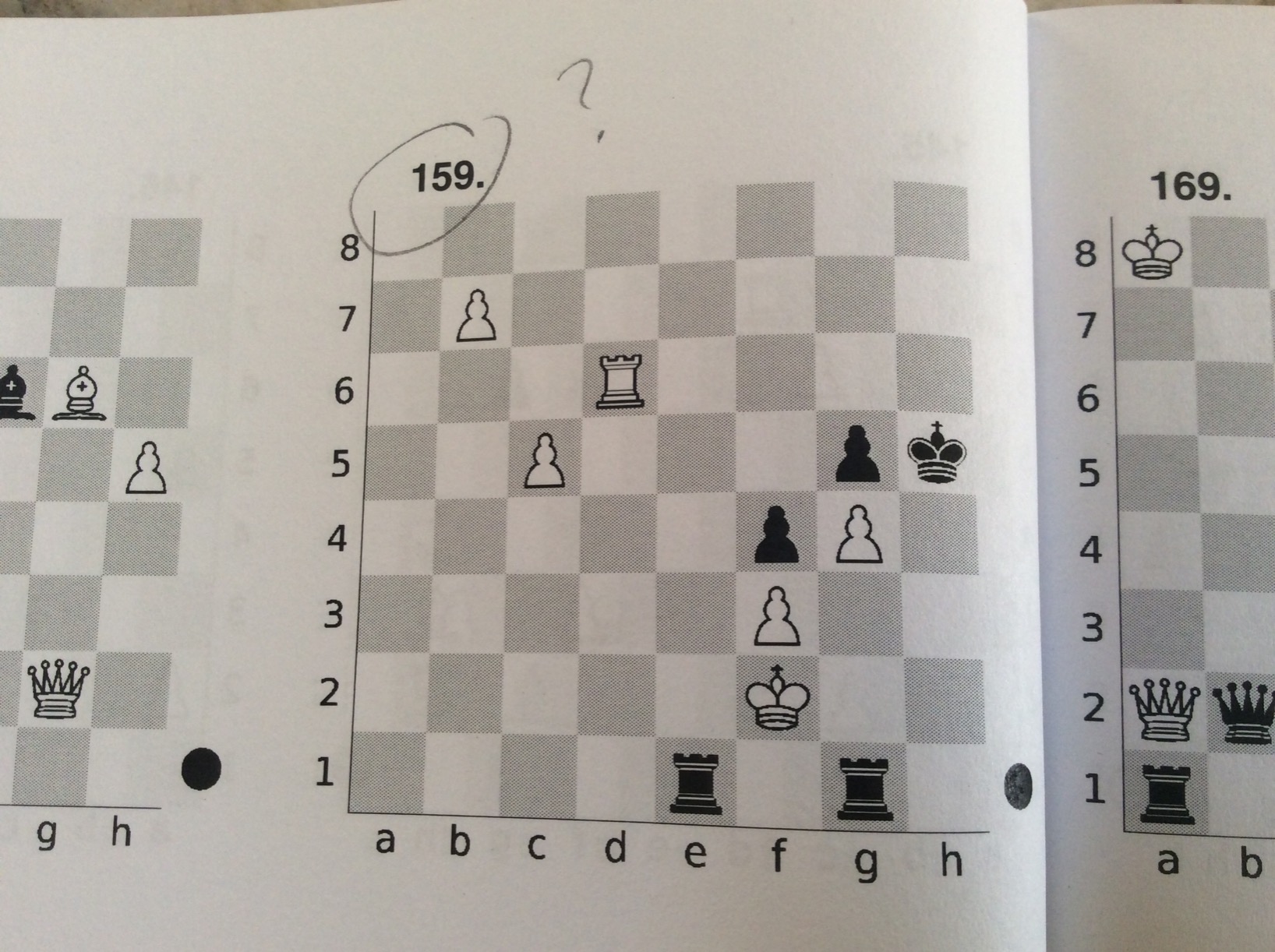
The independently published format keeps costs down, making this one of the most accessible entry points into chess puzzle books. The puzzles are well-suited for both kids and adults who are either learning chess for the first time or returning after a long break. The straightforward mate-in-one format means you can solve puzzles quickly, which builds confidence and momentum.
The downside of fitting 500 puzzles into 52 pages is that you get 12 puzzle boards per page, and they are small. If you have trouble seeing small diagrams, this will frustrate you. Some reviewers also noted numbering errors in the puzzle sequence, which can be confusing when you are trying to check your answers against the solutions section.
Who should buy this book
Complete beginners and returning players who want the simplest possible entry into chess puzzles should start here. This is also an excellent choice for parents introducing young children to checkmate patterns. If you want to build quick confidence with achievable puzzles before moving to harder material, the mate-in-one format delivers that in spades.
Who might want to look elsewhere
Anyone rated above 900 will find these puzzles too easy and will breeze through the book in a single sitting. If you want multi-move puzzles that require calculation, this entire book is single-move checkmates. Players who prefer larger diagrams should look at the full-size format books in our list instead.
How to Choose the Right Chess Puzzle Book
Picking the right chess puzzle book comes down to three things: your current rating, your learning style, and how much time you want to invest. I have watched players buy books that were too advanced, get frustrated, and quit puzzle training entirely. Here is how to avoid that mistake and find the book that will actually help you improve.
Match the Book to Your Rating
Your chess rating is the most important factor in choosing a puzzle book. If you solve puzzles that are too easy, you waste time. If they are too hard, you get frustrated and learn nothing. The sweet spot is what coaches call the “Eighty-Five Percent Rule” where you are solving about 85% of puzzles correctly. Here is a quick rating guide to match you with the right book:
Below 900 ELO: Start with 500 Chess Puzzles, Mate in 1 or Winning Chess Exercises for Kids (even for adults, the visual format works well). These books focus on basic pattern recognition without overwhelming you with complex calculations.
900 to 1300 ELO: The 1001 Chess Exercises for Beginners (either edition) is your best bet. The concept explanations before each section help you understand why the tactics work, and the gradual difficulty progression builds confidence.
1300 to 1600 ELO: Move up to Chess Tactics for Champions by Susan Polgar or the Chess Tactics and Combinations Workbook. Both bridge the gap between beginner and intermediate play with puzzles that require genuine calculation.
1500 to 2000 ELO: The 1001 Chess Exercises for Club Players and 600 Modern Chess Puzzles are ideal. These books feature positions from real games at your level, so the patterns you learn transfer directly to your own games.
Above 2000 ELO: The Ultimate Chess Puzzle Book and the higher-difficulty sections of the Polgar 5334 collection will give you a genuine challenge. At this level, you want curated puzzles with careful solutions that explain deep variations.
Consider the Format
Physical paperback books are still the gold standard for chess puzzle training. You can write notes, circle pieces, and sketch variation trees right on the page. Kindle versions of chess puzzle books consistently get lower ratings because diagrams render poorly on e-reader screens and notation formats do not translate well to digital. If you do go digital, use a tablet rather than a phone or dedicated e-reader.
Large-format books (8.5 x 11 inches) like the Chess Tactics and Combinations Workbook and The Chess Puzzles and Tactics Blueprint offer the best diagram readability. Standard-format books around 6 x 9 inches are more portable but may strain your eyes during long solving sessions. Consider where you plan to use the book most often before choosing a size.
Theme Organization vs. Mixed Puzzles
Books organized by tactical theme (forks in one chapter, pins in the next) help you learn each pattern thoroughly before mixing them up. The downside is that you know what to look for before starting each puzzle, which is not realistic for actual games. Mixed puzzle books, where the tactical motif is unknown, simulate real-game conditions better but can be overwhelming for beginners.
My recommendation is to start with a theme-organized book to learn the patterns, then move to a mixed-puzzle book to test whether you can spot those patterns without knowing what to look for. The 1001 Chess Exercises series does a good job of combining both approaches, starting with themed chapters and then mixing puzzles in later sections.
Paperback vs. Digital for Puzzle Books
I have tested puzzle books in both formats, and paperback wins decisively for chess training. The Kindle versions of almost every book in our roundup have lower ratings than their physical counterparts. Diagrams are too small on phone screens, navigation between puzzles and solutions is clunky, and you cannot write calculations on the page. Save digital for reading chess biographies and opening manuals. For puzzle solving, paper is king.
FAQ
What are the best chess puzzle books?
The best chess puzzle books include Chess: 5334 Problems, Combinations and Games by Laszlo Polgar for overall value, 1001 Chess Exercises for Beginners for new players, Chess Tactics for Champions by Susan Polgar for intermediates, 1001 Chess Exercises for Club Players for ELO 1500-2000, and The Ultimate Chess Puzzle Book by John Emms for advanced players. Your best choice depends on your current rating and experience level.
Which chess puzzles are best for improving tactical skill?
Puzzles organized by tactical motif (forks, pins, skewers, discovered attacks) are best for building pattern recognition. Start with theme-based books like 1001 Chess Exercises for Beginners, then progress to mixed-puzzle books like 600 Modern Chess Puzzles where you must identify the tactic without knowing what to look for. Solving puzzles at 85% accuracy is the optimal difficulty for improvement.
What is considered the best chess book overall?
Chess: 5334 Problems, Combinations and Games by Laszlo Polgar is widely considered the best overall chess puzzle book. With over 5300 problems spanning all difficulty levels and a 4.7-star rating from nearly 2000 reviewers, it provides years of training material. Polgar trained three daughters who became world-class players using this methodology, which gives the book exceptional credibility.
Are chess puzzle books better than online puzzles?
Chess puzzle books and online puzzles each have strengths. Books provide structured progression, instructional text, and the ability to write notes and calculations on the page. Online puzzles offer unlimited variety, adaptive difficulty, and instant feedback. For serious improvement, combining both works best: use a book for structured daily training sessions and online puzzles for volume practice and warm-ups before games.
Final Thoughts on the Best Chess Puzzle Books
Finding the right chess puzzle book can transform your tactical ability in a matter of weeks. After testing these 12 books, my top recommendation for most players is Chess: 5334 Problems by Polgar for its unmatched volume and longevity. Beginners should start with the 1001 Chess Exercises for Beginners for its clear concept explanations, and budget-conscious club players will get excellent value from 600 Modern Chess Puzzles.
The best chess puzzle books are the ones you actually open every day. Pick the book that matches your rating, commit to solving 10 to 20 puzzles per session, and watch your tactical vision sharpen over the coming weeks. Your future self will thank you when you start spotting combinations your opponents never see coming.